CAS 5746-27-0
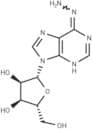
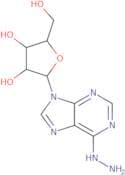
:6-hydrazinyl-9-pentofuranosyl-9H-purine
Description:
6-Hydrazinyl-9-pentofuranosyl-9H-purine, also known by its CAS number 5746-27-0, is a purine derivative characterized by the presence of a hydrazine group at the 6-position and a pentofuranosyl moiety at the 9-position of the purine ring. This compound exhibits properties typical of nucleobases, including the ability to participate in hydrogen bonding, which is crucial for its potential role in biological systems. The hydrazine functional group may impart unique reactivity, making it of interest in medicinal chemistry and biochemistry, particularly in the context of nucleoside analogs. Its structural features suggest potential applications in antiviral or anticancer therapies, as modifications to purine structures can influence biological activity. Additionally, the compound's solubility, stability, and interaction with biological macromolecules would be essential factors to consider in its practical applications. Overall, 6-hydrazinyl-9-pentofuranosyl-9H-purine represents a fascinating area of study within the realm of synthetic and medicinal chemistry.
Formula:C10H14N6O4
InChI:InChI=1/C10H14N6O4/c11-15-8-5-9(13-2-12-8)16(3-14-5)10-7(19)6(18)4(1-17)20-10/h2-4,6-7,10,17-19H,1,11H2,(H,12,13,15)
SMILES:C(C1C(C(C(n2cnc3c(ncnc23)NN)O1)O)O)O
Sort by
Purity (%)
0
100
|
0
|
50
|
90
|
95
|
100
Found 2 products.
N6-Aminoadenosine
CAS:Nucleoside Derivatives - 6-Modified purine nucleosides, Amino-nucleosidesFormula:C10H14N6O4Color and Shape:SolidMolecular weight:282.26N6-Aminoadenosine
CAS:N6-Aminoadenosine is a purine nucleoside that is involved in the synthesis of adenosine. It can be found in a number of tissues and has been shown to have an agonist potency similar to 2-phenylaminoadenosine, but with a longer duration of action. N6-Aminoadenosine is also present as one of two stereoisomers, the other being N2-aminoadenosine. These two aminosides are hydrolyzed by triazol and sinoatrial enzymes. The affinity of N6-aminoadenosine for cellular receptors has been shown using high affinity assays on rat heart cells.Purity:Min. 95%