CAS 57641-76-6
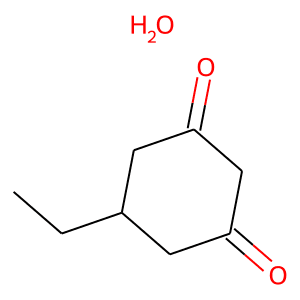
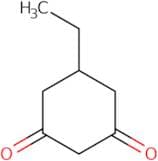
:5-ethylcyclohexane-1,3-dione hydrate
Description:
5-Ethylcyclohexane-1,3-dione hydrate is an organic compound characterized by its cyclic structure and the presence of two carbonyl groups (ketones) at the 1 and 3 positions of the cyclohexane ring, along with an ethyl substituent at the 5 position. The hydrate form indicates that the compound contains water molecules integrated into its structure, which can influence its physical properties and reactivity. Typically, compounds like this may exhibit moderate solubility in polar solvents due to the presence of the carbonyl groups, which can engage in hydrogen bonding. The compound may also participate in various chemical reactions, such as nucleophilic additions or condensation reactions, owing to the electrophilic nature of the carbonyl groups. Its applications could span across organic synthesis, potentially serving as an intermediate in the production of more complex molecules or as a reagent in various chemical transformations. Safety data should be consulted for handling and storage, as with any chemical substance.
Formula:C8H14O3
InChI:InChI=1/C8H12O2.H2O/c1-2-6-3-7(9)5-8(10)4-6;/h6H,2-5H2,1H3;1H2
SMILES:CCC1CC(=O)CC(=O)C1.O
Sort by
Purity (%)
0
100
|
0
|
50
|
90
|
95
|
100
Found 2 products.
5-Ethylcyclohexane-1,3-dione hydrate
CAS:5-Ethylcyclohexane-1,3-dione hydratePurity:≥95%Color and Shape:Beige SolidMolecular weight:158.19g/mol5-Ethylcyclohexane-1,3-dione, hydrate
CAS:5-Ethylcyclohexane-1,3-dione is a hydrate of 5-ethylcyclohexane-1,3-dione. It has been shown to be an allosteric modulator of the metabotropic glutamate receptor and has been used in the synthesis of juglone. The modification of 5-ethylcyclohexane-1,3-dione has been studied using a number of methodologies, which have led to its optimization and the development of novel derivatives that may have applications in the treatment of dyskinesia. 5-Ethylcyclohexane-1,3-dione is also a key intermediate for the synthesis of dimethyldioxirane (DMDO), a reagent that can be used for Diels–Alder reactions.Formula:C8H12O2•(H2O)xPurity:Min. 95%Color and Shape:PowderMolecular weight:140.18 g/mol