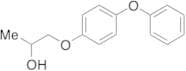
CAS 57650-78-9
:1-(4-PHENOXYPHENOXY)-2-PROPANOL
Description:
1-(4-Phenoxyphenoxy)-2-propanol, with the CAS number 57650-78-9, is an organic compound characterized by its unique structure, which includes a propanol backbone substituted with two phenoxy groups. This compound typically exhibits properties associated with both alcohols and aromatic compounds, such as moderate solubility in organic solvents and potential hydrophilicity due to the hydroxyl (-OH) group. It may display biological activity, making it of interest in pharmaceutical and agrochemical research. The presence of the phenoxy groups can influence its reactivity and interactions, potentially allowing for applications in various chemical syntheses or as a functional material. Additionally, the compound's stability and reactivity can be affected by environmental factors such as pH and temperature. Safety data sheets should be consulted for handling and toxicity information, as with any chemical substance. Overall, 1-(4-phenoxyphenoxy)-2-propanol represents a versatile compound with potential applications in multiple fields, including medicinal chemistry and materials science.
Sort by
Purity (%)
0
100
|
0
|
50
|
90
|
95
|
100
Found 4 products.
1-(4-Phenoxyphenoxy)-2-propanol
CAS:Applications 1-(4-Phenoxyphenoxy)-2-propanol is a metabolite of Pyriproxyfen (P998850); a pyridine-based pesticide used against a variety of arthropoda, in particular to protect cotton crops against whitefly.
References Amiri, A., et al.: J. Agri. Sci. Technol., 14, 1205 (2012); Basit, M., et al.: Crop. Protect., 44, 135 (2013)Formula:C15H16O3Color and Shape:NeatMolecular weight:244.291-(4-Phenoxyphenoxy)-2-propanol
CAS:1-(4-Phenoxyphenoxy)-2-propanol is an analog of a Chinese medicinal herb that has shown promising results as an anticancer agent. It works by inhibiting kinase activity, which is essential for cancer cell growth and proliferation. This compound has been found to induce apoptosis, or programmed cell death, in several types of human cancer cells, including leukemia. It is a potent inhibitor of protein kinases, making it a promising candidate for the development of new cancer therapies. In addition, 1-(4-Phenoxyphenoxy)-2-propanol has been detected in urine samples from patients with tumors, indicating its potential as a diagnostic tool for cancer detection and monitoring. Overall, this compound shows great potential as a powerful anticancer agent and warrants further investigation.Formula:C15H16O3Purity:Min. 95%Molecular weight:244.28 g/mol