CAS 5769-13-1
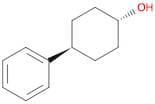
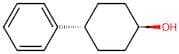
:trans-4-Phenylcyclohexanol
Description:
Trans-4-Phenylcyclohexanol is an organic compound characterized by its cyclohexane ring substituted with a phenyl group and a hydroxyl group (–OH) at the 4-position, resulting in a trans configuration. This compound is a colorless to pale yellow solid at room temperature and is known for its moderate solubility in organic solvents such as ethanol and ether, while being less soluble in water due to its hydrophobic cyclohexane structure. Trans-4-Phenylcyclohexanol exhibits chiral properties, leading to the existence of enantiomers, although it is often encountered as a racemic mixture. The compound is of interest in various fields, including organic synthesis and materials science, due to its potential applications in the development of pharmaceuticals and as a chiral auxiliary in asymmetric synthesis. Its melting and boiling points, as well as its reactivity, can vary based on the specific conditions and purity of the sample. Safety data indicates that, like many organic compounds, it should be handled with care, using appropriate safety measures to avoid inhalation or skin contact.
Formula:C12H16O
InChI:InChI=1/C12H16O/c13-12-8-6-11(7-9-12)10-4-2-1-3-5-10/h1-5,11-13H,6-9H2/t11-,12-
InChI key:InChIKey=YVVUSIMLVPJXMY-HAQNSBGRNA-N
SMILES:O[C@H]1CC[C@@H](CC1)C2=CC=CC=C2
Synonyms:- Cyclohexanol, 4-phenyl-, trans-
- Trans-4-Phenylcyclohexanol
- trans-4-Phenyl-1-cyclohexanol
- trans-4-Phenylcyclohexan-1-ol
Sort by
Purity (%)
0
100
|
0
|
50
|
90
|
95
|
100
Found 4 products.
trans-4-phenylcyclohexan-1-ol
CAS:Formula:C12H16OPurity:98%Color and Shape:SolidMolecular weight:176.25484-Phenylcyclohexan-1-ol
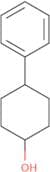
CAS:4-Phenylcyclohexan-1-ol is an organic compound with the chemical formula C10H12O. It is a colorless liquid with a sweet odor. It is produced by the oxidation of naphthalene and isopropylbenzyl alcohol in the presence of a catalyst such as iron(III) sulfate, potassium permanganate, or manganese dioxide. The reaction mechanism begins with the formation of furyl radicals from naphthalene and isopropylbenzyl alcohol. These radicals then react to form 4-phenylcyclohexan-1-ol. 4-Phenylcyclohexan-1-ol has been found to serve as an electron donor in catalysis, where it participates in the conversion of hydrocarbons into aromatic hydrocarbons. It also participates in biosynthesis through its role in fatty acid synthesis.Formula:C12H16OPurity:Min. 95%Molecular weight:176.25 g/mol