CAS 577-71-9
:3,4-Dinitrophenol
Description:
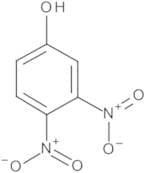
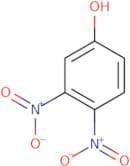
3,4-Dinitrophenol (DNP) is an organic compound characterized by its yellow crystalline appearance and a distinctive aromatic structure. It is a derivative of phenol, featuring two nitro groups (-NO2) positioned at the 3 and 4 carbon atoms of the benzene ring. DNP is known for its role as a herbicide and a chemical intermediate in various industrial applications. It is highly soluble in organic solvents but has limited solubility in water. The compound exhibits strong acidity, making it a weak acid in aqueous solutions. DNP is also recognized for its ability to uncouple oxidative phosphorylation in cellular respiration, leading to increased metabolic rates and heat production, which has raised concerns regarding its safety and potential toxicity. Due to its hazardous nature, including risks of severe health effects upon exposure, DNP is subject to strict regulations in many countries. Its use in weight loss products has been banned in several jurisdictions due to serious health risks, including potential fatal outcomes.
Formula:C6H4N2O5
InChI:InChI=1S/C6H4N2O5/c9-4-1-2-5(7(10)11)6(3-4)8(12)13/h1-3,9H
InChI key:InChIKey=AKLOLDQYWQAREW-UHFFFAOYSA-N
SMILES:N(=O)(=O)C1=C(N(=O)=O)C=C(O)C=C1
Synonyms:- 3,4-Dinitrophenol
- 3,4-Dnp
- Phenol, 3,4-dinitro-
- Phenol, δ-dinitro-
Sort by
Purity (%)
0
100
|
0
|
50
|
90
|
95
|
100
Found 4 products.
3,4-Dinitrophenol(wetted with water >15%)
CAS:Controlled ProductApplications The effect of pH, ionic strength, and compd. concn. on the liposome-water distribution ratio has been investigated for 3,4-Dinitrophenol.
E0
References Escher, B., et al.: Environ. Sci. Technol., 30, 260 (1996)Formula:C6H4N2O5Color and Shape:NeatMolecular weight:184.113,4-Dinitrophenol
CAS:Controlled Product3,4-Dinitrophenol is a yellow solid that is chemically synthesized from 2,4-dinitrobenzene and morpholine. 3,4-Dinitrophenol is a high energy compound with an activation energy of about 28 kcal/mol. The endpoints for the reaction are oligosaccharides and the acceptor is an ionisation mass. This molecule has a pyrazole ring and can be classified as belonging to group P2 on the periodic table of elements. 3,4-Dinitrophenol has been found to have biological functions in organic solvents such as acetone or benzene.
Formula:C6H4N2O5Purity:Min. 95%Color and Shape:PowderMolecular weight:184.11 g/mol3,4-Dinitrophenol pure, 97%
CAS:Formula:C6H4N2O5Purity:min. 97%Color and Shape:White to yellow to green to brown, Crystalline PowderMolecular weight:184.11