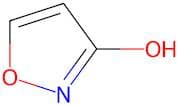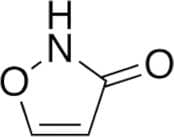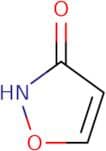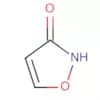
CAS 5777-20-8
:3(2H)-Isoxazolone
Description:
3(2H)-Isoxazolone, with the CAS number 5777-20-8, is a heterocyclic organic compound characterized by a five-membered ring containing both nitrogen and oxygen atoms. This compound features a unique isoxazolone structure, which consists of an isoxazole ring fused with a carbonyl group, contributing to its reactivity and potential applications in various chemical reactions. It typically exhibits properties such as moderate solubility in polar solvents and stability under standard conditions, although it may be sensitive to strong acids or bases. The presence of the carbonyl group in the isoxazolone structure allows for nucleophilic attack, making it useful in synthetic organic chemistry, particularly in the formation of more complex molecules. Additionally, 3(2H)-Isoxazolone may exhibit biological activity, which has led to interest in its potential applications in pharmaceuticals and agrochemicals. Its synthesis often involves cyclization reactions, and it can serve as an intermediate in the preparation of various derivatives, expanding its utility in chemical research and development.
Formula:C3H3NO2
Synonyms:- 3-Isoxazolol
- isoxazol-3(2H)-one
Sort by
Purity (%)
0
100
|
0
|
50
|
90
|
95
|
100
Found 5 products.
3(2H)-Isoxazolone
CAS:Controlled Product<p>Applications 3(2H)-Isoxazolone is a 3-hydroxyisoxazole with fungicidal activity. 3(2H)-Isoxazolone is an impurity of Cycloserine (C988800).<br>References Takahi, Y.: San. Kenk. Nen., 25, 8 (1973);<br></p>Formula:C3H3NO2Color and Shape:NeatMolecular weight:85.061,2-Oxazol-3-ol
CAS:<p>1,2-Oxazol-3-ol is a receptor that binds to nitrogen atoms and has a cavity. It is an α subunit of the GABA receptor and can be found in brain tissue. The 1,2-oxazol-3-ol has been shown to act as a specific agonist for the GABA receptors by binding to the α subunit. This binding increases the uptake of chloride ions into cells and decreases the neuronal activity. This drug also has been shown to have anti-inflammatory properties through inhibition of the production of prostaglandins. 1,2-Oxazol-3-ol was also shown to inhibit acid production in clinical studies when given at high doses in patients with chronic renal failure.</p>Formula:C3H3NO2Purity:Min. 95%Molecular weight:85.06 g/mol