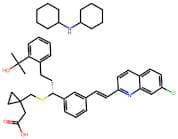
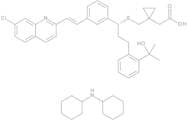
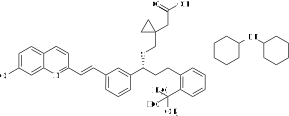
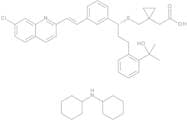
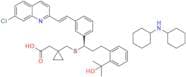
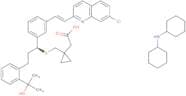
![Cyclopropaneacetic acid, 1-[[[(1R)-1-[3-[(1E)-2-(7-chloro-2-quinolinyl)ethenyl]phenyl]-3-[2-(1-hyd…](/_next/image/?url=https%3A%2Fstatic.cymitquimica.com%2Fcas-image%2Fthumb-webp%2F363505-cyclopropaneacetic-acid-1-1r-1-3-1e-2-7-chloro-2-quinolinyl-ethenyl-phenyl-3-2-1-hydroxy-1-methylethyl-phenyl-propyl-thio-methyl-compd-with-n-cyclohexylcyclohexanamine-1-1.webp&w=3840&q=75)
CAS 577953-88-9
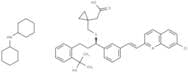
:Cyclopropaneacetic acid, 1-[[[(1R)-1-[3-[(1E)-2-(7-chloro-2-quinolinyl)ethenyl]phenyl]-3-[2-(1-hydroxy-1-methylethyl)phenyl]propyl]thio]methyl]-, compd. with N-cyclohexylcyclohexanamine (1:1)
Description:
Cyclopropaneacetic acid, 1-[[[(1R)-1-[3-[(1E)-2-(7-chloro-2-quinolinyl)ethenyl]phenyl]-3-[2-(1-hydroxy-1-methylethyl)phenyl]propyl]thio]methyl]-, compd. with N-cyclohexylcyclohexanamine (1:1), identified by CAS number 577953-88-9, is a complex organic compound characterized by its unique structural features. This substance contains a cyclopropane ring, which contributes to its strain and reactivity, along with an acetic acid functional group that may impart acidic properties. The presence of multiple aromatic rings and substituents, including a chloroquinoline moiety, suggests potential biological activity, possibly influencing its pharmacological properties. The compound's formulation as a salt with N-cyclohexylcyclohexanamine indicates a potential for enhanced solubility and stability. Its intricate structure may lead to interesting interactions in biological systems, making it a candidate for research in medicinal chemistry. However, specific physical and chemical properties such as melting point, boiling point, and solubility would require empirical data for precise characterization.
Formula:C35H36ClNO3S·C12H23N
InChI:InChI=1S/C35H36ClNO3S.C12H23N/c1-34(2,40)30-9-4-3-7-25(30)13-17-32(41-23-35(18-19-35)22-33(38)39)27-8-5-6-24(20-27)10-15-29-16-12-26-11-14-28(36)21-31(26)37-29;1-3-7-11(8-4-1)13-12-9-5-2-6-10-12/h3-12,14-16,20-21,32,40H,13,17-19,22-23H2,1-2H3,(H,38,39);11-13H,1-10H2/b15-10+;/t32-;/m1./s1
InChI key:InChIKey=ZLOLVGQQYDQBMP-HKHDRNBDSA-N
SMILES:C(S[C@H](CCC1=C(C(C)(C)O)C=CC=C1)C2=CC(/C=C/C3=NC4=C(C=C3)C=CC(Cl)=C4)=CC=C2)C5(CC(O)=O)CC5.N(C1CCCCC1)C2CCCCC2
Synonyms:- 2-[1-[[[(1R)-1-[3-[(1E)-2-(7-Chloro-2-quinolinyl)ethenyl]phenyl]-3-[2-(1-hydroxy-1-methylethyl)phenyl]propyl]thio]methyl]cyclopropyl]acetic acid dicyclohexylamine salt
- Cyclopropaneacetic acid, 1-[[[(1R)-1-[3-[(1E)-2-(7-chloro-2-quinolinyl)ethenyl]phenyl]-3-[2-(1-hydroxy-1-methylethyl)phenyl]propyl]thio]methyl]-, compd. with N-cyclohexylcyclohexanamine (1:1)
- DCHA Salt, Montelukast dicyclohexylamine Salt
- Montelukast dicyclohexylamine salt
Sort by
Purity (%)
0
100
|
0
|
50
|
90
|
95
|
100
Found 13 products.
Montelukast dicyclohexylamine
CAS:Montelukast dicyclohexylamineFormula:C47H59ClN2O3SPurity:99.8%Color and Shape:BeigeMolecular weight:766.39349Montelukast Dicyclohexylamine
CAS:Compounds (excluding drugs and pesticides) containing a quinoline or isoquinoline ring-system (whether or not hydrogenated) not further fused, nesoiFormula:C35H36ClNO3S·C12H23NColor and Shape:White PowderMolecular weight:585.210442-[1-[[[(1R)-1-[3-[(1E)-2-(7-Chloro-2-quinolinyl)ethenyl]phenyl]-3-[2-(1-hydroxy-1-methylethyl)phenyl]propyl]thio]methyl]cyclopropyl]acetic acid dicyclohexylamine salt
CAS:Formula:C47H59ClN2O3SPurity:97%Color and Shape:SolidMolecular weight:767.5010Dicyclohexylamine (R,E)-2-(1-(((1-(3-(2-(7-chloroquinolin-2-yl)vinyl)phenyl)-3-(2-(2-hydroxypropan-2-yl)phenyl)propyl)thio)methyl)cyclopropyl)acetate
CAS:Dicyclohexylamine (R,E)-2-(1-(((1-(3-(2-(7-chloroquinolin-2-yl)vinyl)phenyl)-3-(2-(2-hydroxypropan-2-yl)phenyl)propyl)thio)methyl)cyclopropyl)acetatePurity:97%Molecular weight:767.52g/molMontelukast Dicyclohexylamine
CAS:Controlled ProductFormula:C35H36ClNO3S·C12H23NColor and Shape:NeatMolecular weight:767.50Montelukast dicyclohexylamine
CAS:Montelukast (MK0476), a selective CysLT1 antagonist, treats asthma, liver injury, and is researched for COVID-19.Formula:C47H59ClN2O3SColor and Shape:SolidMolecular weight:767.5Montelukast Dicyclohexylamine Salt
CAS:Formula:C35H36ClNO3S·C12H23NColor and Shape:White To BeigeMolecular weight:767.5Montelukast dicyclohexylamine
CAS:Controlled ProductMontelukast is a leukotriene receptor antagonist that is used as an anti-inflammatory agent. It is a monosodium salt of montelukast, which is a trifluoroacetic acid ester of the fatty acid, dicyclohexylamine. The reaction solution can be in either the polymorphic or monomorphic form. The polymorphic form has been shown to be more stable than the monomorphic form and both forms are soluble in organic solvents such as ethanol and ether. The salt can further react with sulphonic acids, chlorides, benzoates, and inorganic acids to produce other salts.Formula:C47H59ClN2O3SPurity:Min. 95%Color and Shape:PowderMolecular weight:767.5 g/mol


![2-[1-[[[(1R)-1-[3-[(1E)-2-(7-Chloro-2-quinolinyl)ethenyl]phenyl]-3-[2-(1-hydroxy-1-methylethyl)phe…](/_next/image/?url=https%3A%2Fstatic.cymitquimica.com%2Fproducts%2FIN%2Fthumb%2FDA00EFC9.jpg&w=3840&q=75)