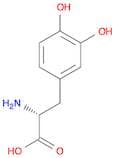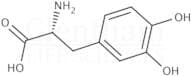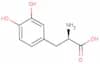
CAS 5796-17-8
:D-Dopa
Description:
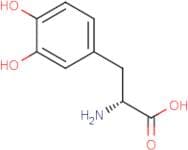
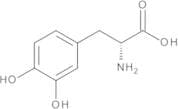
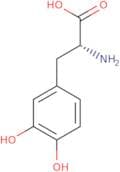
D-Dopa, or Dihydroxyphenylalanine, is an amino acid that serves as a precursor to neurotransmitters, particularly dopamine. It is a chiral compound, existing in two enantiomeric forms: L-Dopa and D-Dopa, with L-Dopa being the biologically active form commonly used in the treatment of Parkinson's disease. D-Dopa is less prevalent in biological systems and is primarily of interest in research contexts. The compound has a molecular formula that includes a phenolic hydroxyl group, contributing to its reactivity and potential interactions in biochemical pathways. D-Dopa is typically characterized by its white crystalline appearance and is soluble in water, which facilitates its use in various experimental applications. Its CAS number, 5796-17-8, uniquely identifies it in chemical databases, aiding in the retrieval of information regarding its properties, synthesis, and potential uses. While D-Dopa itself is not widely used therapeutically, studying its properties can provide insights into the mechanisms of neurotransmitter synthesis and the role of amino acids in neurological functions.
Formula:C9H11NO4
InChI:InChI=1S/C9H11NO4/c10-6(9(13)14)3-5-1-2-7(11)8(12)4-5/h1-2,4,6,11-12H,3,10H2,(H,13,14)/t6-/m1/s1
InChI key:InChIKey=WTDRDQBEARUVNC-ZCFIWIBFSA-N
SMILES:C([C@H](C(O)=O)N)C1=CC(O)=C(O)C=C1
Synonyms:- (+)-3-(3,4-Dihydroxyphenyl)alanine
- (+)-Dopa
- (R)-2-Amino-3-(3,4-dihydroxyphenyl)propanoic acid
- (R)-2-Amino-3-(3,4-dihydroxyphenyl)propanoicacid
- 3,4-Dihydroxy-<span class="text-smallcaps">D</span>-phenylalanine
- 3-(3,4-Dihydroxyphenyl)-<span class="text-smallcaps">D</span>-alanine
- 3-Hydroxy-<span class="text-smallcaps">D</span>-tyrosine
- 3-hydroxy-D-Tyrosine
- <span class="text-smallcaps">D</span>-3,4-Dihydroxyphenylalanine
- <span class="text-smallcaps">D</span>-3-(3,4-Dihydroxyphenyl)alanine
- <span class="text-smallcaps">D</span>-3-Hydroxytyrosine
- <span class="text-smallcaps">D</span>-Dopa
- <span class="text-smallcaps">D</span>-Tyrosine, 3-hydroxy-
- Alanine, 3-(3,4-dihydroxyphenyl)-, <span class="text-smallcaps">D</span>-
- D-Dopa
- β-(3,4-Dihydroxy)-<span class="text-smallcaps">D</span>-phenylalanine
- D-3,4-Dihydroxyphenylalanine
- Alanine, 3-(3,4-dihydroxyphenyl)-, D-
- See more synonyms
Sort by
Purity (%)
0
100
|
0
|
50
|
90
|
95
|
100
Found 10 products.
D-DOPA
CAS:D-DOPA, an L-DOPA enantiomer, alters rat dopamine neurons and can modulate Parkinson's symptoms.
Formula:C9H11NO4Color and Shape:SolidMolecular weight:197.19D-DOPA
CAS:Formula:C9H11NO4Purity:≥ 98.0%Color and Shape:Off-white to light grey or beige solidMolecular weight:197.19(2R)-2-Amino-3-(3,4-dihydroxyphenyl)propanoic acid
CAS:(2R)-2-Amino-3-(3,4-dihydroxyphenyl)propanoic acidPurity:98%Molecular weight:197.19g/molD-DOPA
CAS:Controlled ProductImpurity Levodopa EP Impurity D
Applications D-DOPA (Levodopa EP Impurity D) is a DOPA enantiomer that lacks biological activity.Formula:C9H11NO4Color and Shape:NeatMolecular weight:197.19D-DOPA
CAS:Controlled ProductD-DOPA is a precursor to dopamine that is commonly used in the treatment of Parkinson's disease. It is synthesized from L-tyrosine by the enzyme tyrosine hydroxylase. D-DOPA is also an intermediate in the biosynthesis of melanin and epinephrine. D-DOPA has been shown to be potent inducer of enzymes such as glutamate dehydrogenase and glutamate decarboxylase, which are involved in the synthesis of glutathione, glutamine, and GABA. Dopamine can also inhibit uptake by Streptococcus faecalis, an organism that causes bacterial vaginosis.Formula:C9H11NO4Purity:Min. 95%Color and Shape:PowderMolecular weight:197.19 g/molRef: 4Z-D-32100
Discontinued product