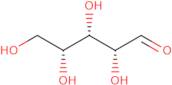
CAS 58-86-6
:(+)-Xylose
Description:
(+)-Xylose, with the CAS number 58-86-6, is a naturally occurring aldopentose sugar, specifically a five-carbon monosaccharide. It is classified as a D-sugar and is commonly found in various plant materials, particularly in the hemicellulose of wood and in some fruits. The molecular formula of (+)-xylose is C5H10O5, and it exists in a crystalline form that is typically white or colorless. This sugar is known for its sweet taste, although it is less sweet than glucose. (+)-Xylose is soluble in water, which facilitates its absorption in biological systems. It plays a significant role in carbohydrate metabolism and is often used in laboratory settings for various biochemical assays, including tests for intestinal absorption. Additionally, it is important in the food industry and can be utilized in the production of xylooligosaccharides, which have prebiotic properties. The compound can exist in different anomeric forms, with the D-configuration being the most prevalent in nature.
Formula:C5H10O5
InChI:InChI=1S/C5H10O5/c6-1-3(8)5(10)4(9)2-7/h1,3-5,7-10H,2H2/t3-,4+,5+/m0/s1
InChI key:InChIKey=PYMYPHUHKUWMLA-VPENINKCSA-N
SMILES:[C@H]([C@@H](CO)O)([C@H](C=O)O)O
Synonyms:- (+)-Xylose
- (2R,3S,4R)-2,3,4,5-Tetrahydroxypentanal
- 2,3,4,5-Tetrahydroxypentanal
- <span class="text-smallcaps">D</span>-(+)-Xylose
- Brn 1562108
- Ccris 1899
- D-xylopyranose
- FEMA No. 3606
- Holzzucker
- Hsdb 3273
- Unii-A1Ta934Ako
- Wood sugar
- Xilosa, Pura
- Xylose, <span class="text-smallcaps">D</span>-
- Xylose, D-
- alpha-D-xylopyranose
- beta-D-xylopyranose
- See more synonyms
Sort by
Purity (%)
0
100
|
0
|
50
|
90
|
95
|
100
D-Xylose
CAS:Xylose (Xyl) is an aldopentose also known as wood sugar (Collins, 2006). The main sources of xylose are hemicelluloses found in hardwood and perennial plants, such as, grasses, cereals, and herbs (Petzold-Welcke, 2014) and some algae. Xylose is used in the production of xylitol, a low calory sugar substitute. Xylose is used in glycosaminoglycan (GAG) biosynthesis, which is initiated by peptide O-xylosyltransferases, which transfer xylose onto selected serine residues in the core proteins. The first enzyme in the pathway, peptide O-xylosyltransferase, catalyzes the transfer of xylose from uridine diphosphate (UDP)-α-D-xylose onto serine and thus determines the site(s) of GAG attachment on the core protein (Briggs, 2018).Formula:C5H10O5Purity:Min. 99.0 Area-%Molecular weight:150.13 g/molRef: 3D-X-7910
Discontinued productD-Xylose - Syrup
CAS:Xylose (Xyl) is an aldopentose also known as wood sugar (Collins, 2006). The main sources of xylose are hemicelluloses found in hardwood and perennial plants, such as, grasses, cereals, and herbs (Petzold-Welcke, 2014) and some algae. Xylose is used in the production of xylitol, a low calory sugar substitute. Xylose is used in glycosaminoglycan (GAG) biosynthesis, which is initiated by peptide O-xylosyltransferases, which transfer xylose onto selected serine residues in the core proteins. The first enzyme in the pathway, peptide O-xylosyltransferase, catalyzes the transfer of xylose from uridine diphosphate (UDP)-α-D-xylose onto serine and thus determines the site(s) of GAG attachment on the core protein (Briggs, 2018).Formula:C5H10O5Purity:Min. 95%Molecular weight:150.13 g/mol