CAS 58028-74-3
:2-(1H-pyrrol-1-yl)benzaldehyde
Description:
2-(1H-pyrrol-1-yl)benzaldehyde, with the CAS number 58028-74-3, is an organic compound characterized by the presence of both a pyrrole and an aldehyde functional group. This compound features a benzaldehyde moiety, where a pyrrole ring is substituted at the ortho position. It typically appears as a yellow to brown liquid or solid, depending on its purity and specific conditions. The compound is known for its aromatic properties, which contribute to its potential applications in organic synthesis and as a building block in the development of pharmaceuticals and agrochemicals. Its structure allows for various chemical reactions, including electrophilic aromatic substitution and nucleophilic addition, making it versatile in synthetic chemistry. Additionally, 2-(1H-pyrrol-1-yl)benzaldehyde may exhibit biological activity, which can be explored for potential therapeutic uses. As with many organic compounds, proper handling and safety precautions are essential due to its potential reactivity and toxicity.
Formula:C11H9NO
InChI:InChI=1/C11H9NO/c13-9-10-5-1-2-6-11(10)12-7-3-4-8-12/h1-9H
SMILES:c1ccc(c(c1)C=O)n1cccc1
Synonyms:- benzaldehyde, 2-(1H-pyrrol-1-yl)-
- 2-(1H-PYRROL-1-YL)BENZALDEHYDE
Sort by
Purity (%)
0
100
|
0
|
50
|
90
|
95
|
100
Found 4 products.
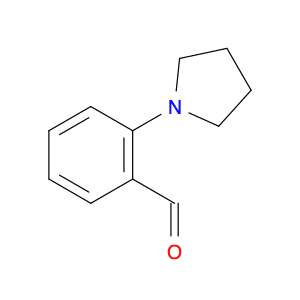
2-Pyrrolidinobenzaldehyde
CAS:Formula:C11H13NOPurity:97%Color and Shape:LiquidMolecular weight:175.22702-(Pyrrolidin-1-yl)benzaldehyde
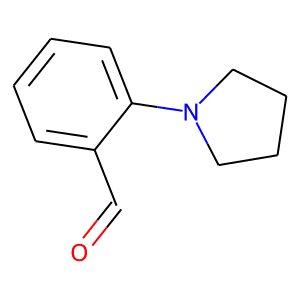
CAS:2-(Pyrrolidin-1-yl)benzaldehydePurity:97%Molecular weight:175.23g/mol2-Pyrrolidin-1-yl-benzaldehyde
CAS:Formula:C11H13NOPurity:97%Color and Shape:LiquidMolecular weight:175.2312-Pyrrolidin-1-yl-benzaldehyde
CAS:2-Pyrrolidin-1-yl-benzaldehyde is an acceptor molecule that can undergo a hydride transfer with a nucleophile. It is also able to undergo a nucleophilic attack on the carbonyl group, which is electrophilic. The benzaldehyde moiety has two lone pairs of electrons, which make it reactive enough to be used in biomolecular synthesis. 2-Pyrrolidin-1-yl-benzaldehyde also spontaneously converts into hexafluoroisopropanol (HFIP) and can be switched between its labile and stable form by changing the pH of the solution. The pyrrole ring is susceptible to oxidation, making it amenable to synthetic reactions. This molecule can also act as an amine donor in reactions where amines are needed as electron donors or acceptors.
Formula:C11H13NOPurity:Min. 95%Molecular weight:175.23 g/mol