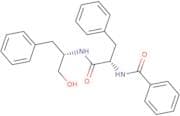
![Nalpha-benzoyl-N-[(2S)-1-hydroxy-3-phenylpropan-2-yl]-L-phenylalaninamide](/_next/image/?url=https%3A%2Fstatic.cymitquimica.com%2Fcas-image%2Fthumb-webp%2F303684-nalpha-benzoyl-n-2s-1-hydroxy-3-phenylpropan-2-yl-l-phenylalaninamide.webp&w=3840&q=75)
CAS 58115-31-4
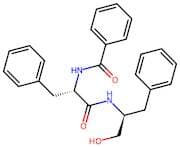
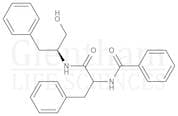
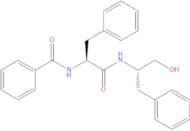
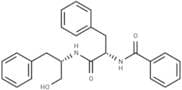
:Nalpha-benzoyl-N-[(2S)-1-hydroxy-3-phenylpropan-2-yl]-L-phenylalaninamide
Description:
Nalpha-benzoyl-N-[(2S)-1-hydroxy-3-phenylpropan-2-yl]-L-phenylalaninamide, with CAS number 58115-31-4, is a synthetic compound that belongs to the class of amino acid derivatives. This substance features a benzoyl group, which contributes to its lipophilicity, and a phenylalanine moiety, which is an essential amino acid known for its role in protein synthesis. The presence of a hydroxy group on the chiral carbon enhances its potential for forming hydrogen bonds, influencing its solubility and reactivity. The compound is characterized by its stereochemistry, specifically the (2S) configuration, which is crucial for its biological activity. It may exhibit properties such as enzyme inhibition or modulation, making it of interest in pharmaceutical research. Additionally, its structural complexity suggests potential interactions with biological targets, which could be explored for therapeutic applications. Overall, this compound exemplifies the intricate relationship between structure and function in medicinal chemistry.
Formula:C25H26N2O3
InChI:InChI=1/C25H26N2O3/c28-18-22(16-19-10-4-1-5-11-19)26-25(30)23(17-20-12-6-2-7-13-20)27-24(29)21-14-8-3-9-15-21/h1-15,22-23,28H,16-18H2,(H,26,30)(H,27,29)/t22-,23-/m0/s1
SMILES:c1ccc(cc1)C[C@@H](CO)N=C([C@H](Cc1ccccc1)N=C(c1ccccc1)O)O
Synonyms:- Aurantiamide
Sort by
Purity (%)
0
100
|
0
|
50
|
90
|
95
|
100
Found 6 products.
Aurantiamide
CAS:Aurantiamide inhibits cancer, inflammation, pain, and neuroinflammation by blocking autophagy and NF-κB, JNK, p38 pathways.Formula:C25H26N2O3Purity:98.88%Color and Shape:SolidMolecular weight:402.49Ref: TM-T5814
1mg130.00€5mg313.00€10mg464.00€25mg740.00€50mg982.00€100mg1,341.00€1mL*10mM (DMSO)444.00€Aurantiamide
CAS:Aurantiamide is a naturally occurring peptide, which is a bioactive compound derived primarily from the root of the licorice plant (Glycyrrhiza glabra). This tripeptide compound is characterized by its unique structural properties that contribute to its biological activity. The mode of action of Aurantiamide involves modulation of inflammatory pathways, most notably through the inhibition of the production of pro-inflammatory cytokines. This is achieved by interfering with signaling cascades that lead to the expression of these cytokines, thus exerting a regulatory effect on inflammatory responses.Formula:C25H26N2O3Purity:Min. 95%Molecular weight:402.5 g/mol