CAS 5813-37-6
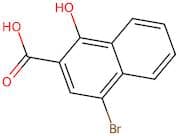
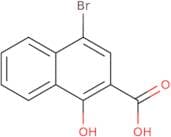
:4-bromo-1-hydroxynaphthalene-2-carboxylic acid
Description:
4-Bromo-1-hydroxynaphthalene-2-carboxylic acid, with the CAS number 5813-37-6, is an organic compound that belongs to the class of naphthalene derivatives. This substance features a naphthalene ring system substituted with a bromine atom, a hydroxyl group, and a carboxylic acid group, which contribute to its chemical reactivity and properties. The presence of the hydroxyl group indicates that it can participate in hydrogen bonding, enhancing its solubility in polar solvents. The carboxylic acid group provides acidic characteristics, allowing it to donate protons in solution. Additionally, the bromine substituent can influence the compound's reactivity, making it a potential candidate for further chemical modifications or reactions. This compound may exhibit biological activity, making it of interest in pharmaceutical research. Its structural features suggest potential applications in organic synthesis, materials science, and as an intermediate in the production of other chemical compounds. Safety data should be consulted for handling and storage, as with all chemical substances.
Formula:C11H7BrO3
InChI:InChI=1/C11H7BrO3/c12-9-5-8(11(14)15)10(13)7-4-2-1-3-6(7)9/h1-5,13H,(H,14,15)
SMILES:c1ccc2c(c1)c(cc(c2O)C(=O)O)Br
Synonyms:- 2-Naphthalenecarboxylic Acid, 4-Bromo-1-Hydroxy-
- 4-Bromo-1-hydroxy-2-naphthoic acid
Sort by
Purity (%)
0
100
|
0
|
50
|
90
|
95
|
100
Found 3 products.
4-Bromo-1-hydroxy-2-naphthoic acid
CAS:4-Bromo-1-hydroxy-2-naphthoic acidPurity:97%Molecular weight:267.08g/mol4-Bromo-1-hydroxy-2-naphthoic acid
CAS:Formula:C11H7BrO3Purity:97%Color and Shape:SolidMolecular weight:267.0784-bromo-1-hydroxynaphthalene-2-carboxylic acid
CAS:4-Bromo-1-hydroxynaphthalene-2-carboxylic acid (4BHN) is a spectroscopic compound that has been used as a radioligand to study the binding of dopamine and dopamine D3 receptors. This compound binds to the d3 receptor with high affinity and specificity, but it does not interact with the d1 or d2 receptors. 4BHN has been shown to act as an agonist at the dopamine D3 receptor. It also acts as an antagonist at the piperidine site of the dopamine D2 receptor. The effects of 4BHN are reversible, which means that it can be displaced by unlabeled 4BHN or other compounds that bind to the same site on the receptor. This technique is useful for studying drug interactions and for determining whether drugs have a subtype selectivity profile.
Formula:C11H7BrO3Purity:Min. 95%Molecular weight:267.1 g/mol