CAS 5837-73-0
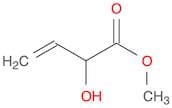
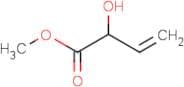
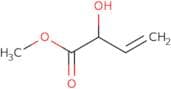
:3-Butenoic acid, 2-hydroxy-, methyl ester
Description:
3-Butenoic acid, 2-hydroxy-, methyl ester, also known as methyl 2-hydroxy-3-butenoate, is an organic compound characterized by its ester functional group and a double bond in its carbon chain. It features a hydroxyl group (-OH) attached to the second carbon of a four-carbon chain, which contributes to its reactivity and potential applications in organic synthesis. This compound is typically a colorless to pale yellow liquid with a fruity odor, indicating its potential use in flavoring and fragrance industries. It is soluble in organic solvents and exhibits moderate polarity due to the presence of both the ester and hydroxyl groups. The compound can participate in various chemical reactions, including esterification and polymerization, making it valuable in the production of polymers and other chemical intermediates. Safety data indicates that it should be handled with care, as it may cause irritation upon contact with skin or eyes. Overall, 3-butenoic acid, 2-hydroxy-, methyl ester is a versatile compound with applications in both industrial and research settings.
Formula:C5H8O3
InChI:InChI=1S/C5H8O3/c1-3-4(6)5(7)8-2/h3-4,6H,1H2,2H3
InChI key:InChIKey=JBKTVPSFVUFSAO-UHFFFAOYSA-N
SMILES:C(C(OC)=O)(C=C)O
Synonyms:- 2-Hydroxy-3-butenoic acid methyl ester
- 3-Butenoic acid, 2-hydroxy-, methyl ester
- Methyl 2-Hydroxybut-3-Enoate
- Methyl 2-hydroxy-3-butenoate
- Methyl vinylglycolate
Sort by
Purity (%)
0
100
|
0
|
50
|
90
|
95
|
100
Found 3 products.
Methyl 2-hydroxybut-3-enoate
CAS:Methyl 2-hydroxybut-3-enoateFormula:C5H8O3Purity:95%Color and Shape: yellow liquidMolecular weight:116.12g/molMethyl 2-hydroxybut-3-enoate
CAS:Methyl 2-hydroxybut-3-enoate is an organic solvent that can be used for the synthesis of monomers and polymers. This molecule has a functional group, a metal ion, and an acid catalyst. It is also efficient for the synthesis of lipids and fatty acids. Methyl 2-hydroxybut-3-enoate is synthesized by reacting with potassium ions in an alcohol solution with a lipase as the catalyst. This reaction may be carried out using radiation or metathesis reactions. The product may also be used as a solid catalyst for other reactions such as hydrogenation, esterification, dehydrogenation, oxidation, hydrolysis, and polymerization.Formula:C5H8O3Purity:Min. 95%Molecular weight:116.12 g/mol