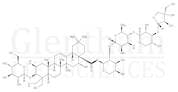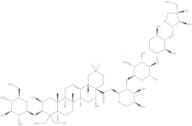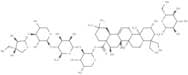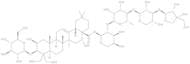
CAS 58479-68-8
:Platycodin D
Description:
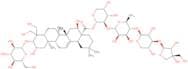
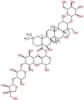
Platycodin D is a triterpenoid saponin primarily derived from the root of Platycodon grandiflorus, a plant commonly used in traditional medicine, particularly in East Asia. It is known for its various biological activities, including anti-inflammatory, immunomodulatory, and anticancer properties. The chemical structure of Platycodin D features a dammarane-type skeleton, which contributes to its bioactivity. It is typically characterized by its solubility in water and organic solvents, although its solubility can vary depending on the solvent used. Platycodin D has been the subject of numerous studies investigating its pharmacological effects, including its potential to enhance respiratory health and its role in modulating immune responses. Additionally, it exhibits cytotoxic effects against certain cancer cell lines, making it a compound of interest in cancer research. As with many natural products, the extraction and purification processes can influence its efficacy and bioavailability, highlighting the importance of proper analytical techniques in studying its properties and applications.
Formula:C57H92O28
InChI:InChI=1S/C57H92O28/c1-23-40(81-45-39(72)41(28(64)18-76-45)82-49-43(73)56(75,21-61)22-78-49)36(69)38(71)46(79-23)83-42-33(66)27(63)17-77-48(42)85-50(74)57-12-11-51(2,3)13-25(57)24-7-8-30-52(4)14-26(62)44(84-47-37(70)35(68)34(67)29(16-58)80-47)55(19-59,20-60)31(52)9-10-53(30,5)54(24,6)15-32(57)65/h7,23,25-49,58-73,75H,8-22H2,1-6H3/t23-,25-,26-,27-,28+,29+,30+,31+,32+,33-,34+,35-,36-,37+,38+,39+,40-,41-,42+,43-,44-,45-,46-,47-,48-,49-,52+,53+,54+,56+,57+/m0/s1
InChI key:InChIKey=CYBWUNOAQPMRBA-NDTOZIJESA-N
SMILES:C(O[C@H]1[C@H](O[C@H]2[C@H](O)[C@H](O)[C@@H](O[C@H]3[C@H](O)[C@@H](O[C@H]4[C@H](O)[C@](CO)(O)CO4)[C@H](O)CO3)[C@H](C)O2)[C@@H](O)[C@@H](O)CO1)(=O)[C@]56[C@](C=7[C@@](C)(C[C@H]5O)[C@@]8(C)[C@](CC7)([C@]9(C)[C@@](CC8)(C(CO)(CO)[C@@H](O[C@@H]%10O[C@H](CO)[C@@H](O)[C@H](O)[C@H]%10O)[C@@H](O)C9)[H])[H])(CC(C)(C)CC6)[H]
Synonyms:- (1-2)-L-arabinopyranosyl ester, (2beta,3beta,16alpha)-
- 2,16,23,24-tetrahydroxy-, O-D-apio-beta-D-furanosyl-(1-3)-O-
- 3-O-[(2S,3R,4R)-3,4-dihydroxy-4-(hydroxymethyl)tetrahydrofuran-2-yl]-beta-D-xylopyranosyl-(1->4)-6-deoxy-alpha-L-mannopyranosyl-(1->2)-1-O-[(2beta,3beta,16alpha)-3-(beta-D-glucopyranosyloxy)-2,16,23,24-tetrahydroxy-28-oxoolean-12-en-28-yl]-alpha-L-arabinopyranose
- Olean-12-en-28-oic acid, 3-(beta-D-glucopyranosyloxy)-
- Olean-12-en-28-oic acid, 3-(β-<span class="text-smallcaps">D</smallcap>-glucopyranosyloxy)-2,16,23,24-tetrahydroxy-, O-<smallcap>D</smallcap>-apio-β-<smallcap>D</smallcap>-furanosyl-(1→3)-O-β-<smallcap>D</smallcap>-xylopyranosyl-(1→4)-O-6-deoxy-α-<smallcap>L</smallcap>-mannopyranosyl-(1→2)-α-<smallcap>L</span>-arabinopyranosyl ester, (2β,3β,16α)-
- beta-D-xylopyranosyl-(1-4)-O-6-deoxy-alpha-L-mannopyranosyl-
- beta-D-xylopyranosyl-(1-4)-O-6-deoxy-alpha-L-mannopyranosyl-
- (1-2)-L-arabinopyranosyl ester, (2beta,3beta,16alpha)-
- Olean-12-en-28-oic acid, 3-(beta-D-glucopyranosyloxy)-
- 2,16,23,24-tetrahydroxy-, O-D-apio-beta-D-furanosyl-(1-3)-O-
- Olean-12-en-28-oic acid, 3-(β-D-glucopyranosyloxy)-2,16,23,24-tetrahydroxy-, O-D-apio-β-D-furanosyl-(1→3)-O-β-D-xylopyranosyl-(1→4)-O-6-deoxy-α-L-mannopyranosyl-(1→2)-α-L-arabinopyranosyl ester, (2β,3β,16α)-
- See more synonyms
Sort by
Purity (%)
0
100
|
0
|
50
|
90
|
95
|
100
Found 9 products.
Platycodin D
CAS:Platycodon D (PD) and D3 (PD3) isolated from Platycodon grandiflorum has been previously reported to show anti-inflammatory activities in rats, PD may stimulate TNF-α synthesis or inhibit degradation of TNF-α mRNA, suggest a dichotomous regulation of these important proinflammatory mediators by PD and PD3.Formula:C57H92O28Purity:95%~99%Color and Shape:White powderMolecular weight:1225.34Platycodin D
CAS:Platycodin D may stimulate TNF-α synthesis or inhibit degradation of TNF-α mRNA.Formula:C57H92O28Purity:99.2% - 99.65%Color and Shape:SolidMolecular weight:1225.32Platycodin d
CAS:Natural glycosideFormula:C57H92O28Purity:≥ 98.0 % (HPLC)Color and Shape:PowderMolecular weight:1225.34Platycodin D
CAS:Controlled ProductApplications Platycodin D is a known inhibitor of the proliferation of human gastric cancer cells as well as inducing apoptosis. It also causes anti-atherosclerotic.
References Wu, J. et al.: Biol. Pharm. Bull. 35, 1216 (2012); Chun, J. et al.: J. Cell. Biochem., 114, 456 (2013);Formula:C57H92O28Color and Shape:NeatMolecular weight:1225.32Platycodin D
CAS:Platycodin D is a natural product that belongs to the class of platycodins. It is a polysaccharide with anti-inflammatory properties and has been shown to suppress inflammation, oxidative injury, and improve mitochondrial function in vitro. Platycodin D also inhibits Toll-like receptor (TLR) signaling pathways that are activated by extracellular bacteria or their products. Platycodin D binds to dsDNA and inhibits DNA binding proteins such as dextran sulfate. This interaction prevents the induction of the inflammatory response. The effects of platycodin D have been demonstrated in an experimental model involving mice. In vivo studies on rats have shown that this compound has an anti-inflammatory effect and reduces oxidative injury.Formula:C57H92O28Purity:Min. 98 Area-%Color and Shape:PowderMolecular weight:1,225.32 g/mol