CAS 585-95-5
:Progoitrin
Description:
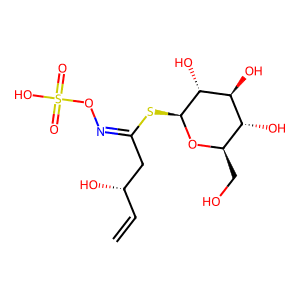
Progoitrin is a naturally occurring glucosinolate, primarily found in cruciferous vegetables such as cabbage, broccoli, and Brussels sprouts. It is characterized by its chemical structure, which includes a thioglucose moiety and a side chain derived from the amino acid phenylalanine. Progoitrin is known for its potential goitrogenic effects, which can interfere with thyroid hormone synthesis by inhibiting iodine uptake in the thyroid gland. This compound is hydrolyzed by the enzyme myrosinase to produce various bioactive products, including isothiocyanates, which have been studied for their potential anticancer properties. Progoitrin is soluble in water and exhibits stability under acidic conditions, but it can degrade under alkaline conditions. Its presence in the diet is often associated with both beneficial health effects and potential risks, particularly in individuals with iodine deficiency. Overall, progoitrin serves as an important example of the complex interactions between dietary components and human health.
Formula:C11H19NO10S2
InChI:InChI=1S/C11H19NO10S2/c1-2-5(14)3-7(12-22-24(18,19)20)23-11-10(17)9(16)8(15)6(4-13)21-11/h2,5-6,8-11,13-17H,1,3-4H2,(H,18,19,20)/t5-,6+,8+,9-,10+,11-/m0/s1
InChI key:InChIKey=MYHSVHWQEVDFQT-ILPXZUKPSA-N
SMILES:S(C(C[C@H](C=C)O)=NOS(=O)(=O)O)[C@@H]1O[C@H](CO)[C@@H](O)[C@H](O)[C@H]1O
Synonyms:- β-D-Glucopyranose, 1-thio-, 1-[(3R)-3-hydroxy-N-(sulfooxy)-4-pentenimidate]
- Progoitrin
- β-D-Glucopyranose, 1-thio-, 1-[3-hydroxy-N-(sulfooxy)-4-pentenimidate], (R)-
- Glucorapiferin
- Glucopyranose, 1-thio-, 1-((R)-3-hydroxy-4-pentenohydroximate) NO-(hydrogen sulfate), β-D-
Sort by
Purity (%)
0
100
|
0
|
50
|
90
|
95
|
100
Found 3 products.
Progoitrin
CAS:Progoitrin, a glucosinolate in certain foods, turns into goitrin after consumption, reducing thyroid hormones and yielding CHB and CHEB.Formula:C11H19NO10S2Purity:98.26% - 98.75%Color and Shape:SolidMolecular weight:389.4Progoitrin
CAS:Progoitrin is a protein that has been found to have potential as an anticancer agent. It acts by inducing apoptosis, or programmed cell death, in cancer cells. Progoitrin also contains inhibitors that can inhibit the activity of certain enzymes involved in cancer cell growth and proliferation. This compound has been used in traditional Chinese medicine for its medicinal properties and has shown promising results in inhibiting tumor growth. Additionally, progoitrin has been found to have inhibitory effects on chitinase and heparinase, which may be useful for treating diseases such as asthma and thrombosis. Research has also shown that progoitrin can act as a kinase inhibitor, which could be useful for developing new treatments for cancer.Formula:C11H19NO10S2Purity:Min. 95%Molecular weight:389.4 g/mol