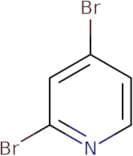
CAS 58530-53-3
:2,4-Dibromo-pyridine
Description:
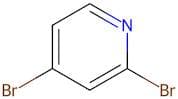
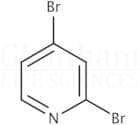
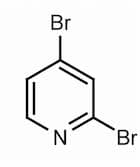
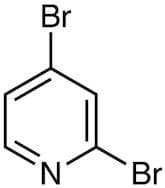
2,4-Dibromo-pyridine is a heterocyclic organic compound characterized by a pyridine ring substituted with two bromine atoms at the 2 and 4 positions. Its molecular formula is C5H3Br2N, and it features a nitrogen atom within the aromatic ring, contributing to its basicity and reactivity. This compound typically appears as a colorless to light yellow liquid or solid, depending on temperature and purity. It is known for its moderate solubility in organic solvents and limited solubility in water. 2,4-Dibromo-pyridine is utilized in various applications, including as an intermediate in the synthesis of pharmaceuticals, agrochemicals, and other organic compounds. The presence of bromine atoms enhances its reactivity, making it a valuable building block in organic synthesis. Additionally, it exhibits potential biological activity, which is of interest in medicinal chemistry. As with many brominated compounds, it is important to handle 2,4-dibromo-pyridine with care due to its potential environmental and health impacts.
Formula:C5H3Br2N
InChI:InChI=1/C5H3Br2N/c6-4-1-2-8-5(7)3-4/h1-3H
SMILES:c1cnc(cc1Br)Br
Synonyms:- 2,4-Dibromopyridine
- Pyridine,2,4-dibromo-
Sort by
Purity (%)
0
100
|
0
|
50
|
90
|
95
|
100
Found 7 products.
2,4-Dibromopyridine
CAS:2,4-DibromopyridineFormula:C5H3Br2NPurity:97%Color and Shape: white to off-white solidMolecular weight:236.89202g/mol2,4-Dibromopyridine
CAS:Formula:C5H3Br2NPurity:>98.0%(GC)Color and Shape:White or Colorless to Almost white or Almost colorless powder to lump to clear liquidMolecular weight:236.892,4-Dibromopyridine
CAS:2,4-Dibromopyridine is a brominated derivative of pyridine. It is synthesized through the substitution of two bromine atoms for two hydrogens on the pyridine ring. This synthesis can be achieved by disubstitution or cross-coupling reactions. The reaction products are nucleophilic and react with electrophiles to produce substitution products. The reaction mechanism is thought to involve a six-membered transition state, which has been observed using X-ray absorption spectroscopy.
Formula:C5H3Br2NPurity:Min. 95%Color and Shape:White To Off-White SolidMolecular weight:236.89 g/mol