CAS 58534-94-4
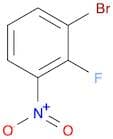
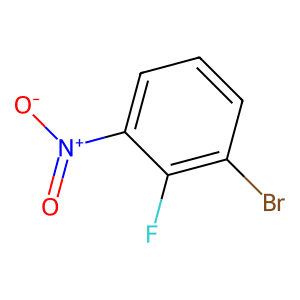
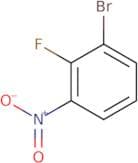
:3-Bromo-2-fluoronitrobenzene
Description:
3-Bromo-2-fluoronitrobenzene is an aromatic compound characterized by the presence of a bromine atom, a fluorine atom, and a nitro group attached to a benzene ring. Its molecular structure features a nitro group (-NO2) and halogen substituents, which influence its reactivity and physical properties. This compound typically appears as a yellow to brown solid and is known for its moderate solubility in organic solvents. The presence of electronegative halogens and the nitro group contributes to its electron-withdrawing characteristics, making it a useful intermediate in organic synthesis, particularly in the production of pharmaceuticals and agrochemicals. Additionally, 3-bromo-2-fluoronitrobenzene can participate in various chemical reactions, including nucleophilic substitutions and electrophilic aromatic substitutions, due to the reactivity of its functional groups. Safety precautions should be observed when handling this compound, as it may pose health hazards, including toxicity and environmental concerns.
Formula:C6H3BrFNO2
InChI:InChI=1/C6H3BrFNO2/c7-4-2-1-3-5(6(4)8)9(10)11/h1-3H
SMILES:c1cc(c(c(c1)N(=O)=O)F)Br
Synonyms:- 1-Bromo-2-fluoro-3-nitrobenzene
- Wnr Bf Ce
- 2-Fluoro-3-broMonitrobenzene
Sort by
Purity (%)
0
100
|
0
|
50
|
90
|
95
|
100
Found 4 products.
3-Bromo-2-fluoronitrobenzene
CAS:Formula:C6H3BrFNO2Purity:98%Color and Shape:SolidMolecular weight:219.99593-Bromo-2-fluoronitrobenzene
CAS:3-Bromo-2-fluoronitrobenzeneFormula:C6H3BrFNO2Purity:98%Color and Shape: clear. red/brown fused solidMolecular weight:219.99592g/mol3-Bromo-2-fluoronitrobenzene
CAS:Formula:C6H3BrFNO2Purity:95%Color and Shape:Solid, Low Melting SolidMolecular weight:219.9971-Bromo-2-fluoro-3-nitrobenzene
CAS:1-Bromo-2-fluoro-3-nitrobenzene is a synthetic chemical that is used as an intermediate in the synthesis of various dyes. It can be obtained by the diazotization of acetyl nitrite and acetonitrile, followed by acetylation with acetic anhydride and hydrolysis with sodium hydroxide. The bromoaniline formed after this reaction is then converted to 1-bromo-2-fluoro-3-nitrobenzene by refluxing it with nitric acid. This chemical can also be synthesized from bromines and chloride in the presence of a diazo salt. It reacts with fluoride or halogens to produce fluorobenzene derivatives, which are used as intermediates for other organic compounds.Formula:C6H3BrFNO2Purity:Min. 95%Color and Shape:Yellow PowderMolecular weight:220 g/mol