CAS 5866-97-7
:2,6-Dichloro-3-nitrobenzaldehyde
Description:
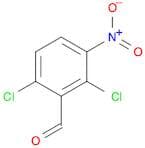
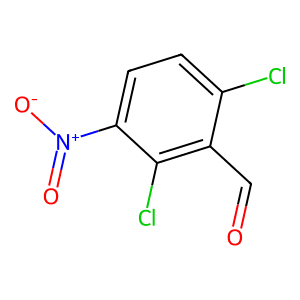
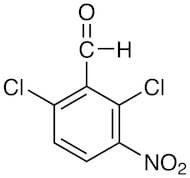
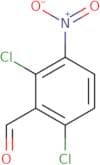
2,6-Dichloro-3-nitrobenzaldehyde is an organic compound characterized by its aromatic structure, featuring a benzaldehyde functional group with two chlorine atoms and a nitro group attached to the benzene ring. The presence of the two chlorine substituents at the 2 and 6 positions, along with the nitro group at the 3 position, contributes to its unique reactivity and properties. This compound typically appears as a yellow to orange crystalline solid and is sparingly soluble in water but more soluble in organic solvents such as ethanol and acetone. It is often used in organic synthesis and as an intermediate in the production of various pharmaceuticals and agrochemicals. The compound exhibits electrophilic aromatic substitution behavior due to the electron-withdrawing nature of the nitro and chloro groups, influencing its reactivity in further chemical transformations. Safety precautions should be taken when handling this compound, as it may pose health risks, including potential toxicity and environmental hazards.
Formula:C7H3Cl2NO3
InChI:InChI=1/C7H3Cl2NO3/c8-5-1-2-6(10(12)13)7(9)4(5)3-11/h1-3H
SMILES:c1cc(c(c(C=O)c1Cl)Cl)N(=O)=O
Sort by
Purity (%)
0
100
|
0
|
50
|
90
|
95
|
100
Found 5 products.
2,6-Dichloro-3-nitrobenzaldehyde
CAS:Formula:C7H3Cl2NO3Purity:98%Color and Shape:SolidMolecular weight:220.00962,6-Dichloro-3-nitrobenzaldehyde
CAS:2,6-Dichloro-3-nitrobenzaldehydePurity:98%Molecular weight:220.01g/mol2,6-Dichloro-3-nitrobenzaldehyde
CAS:Formula:C7H3Cl2NO3Purity:>98.0%(GC)Color and Shape:White to Light yellow to Light orange powder to crystalMolecular weight:220.012,6-Dichloro-3-nitrobenzaldehyde
CAS:2,6-Dichloro-3-nitrobenzaldehyde (DCNB) is an electrophilic bidentate ligand that reacts with chlorine to form chloroform. It is also a good ligand for many metal ions, such as copper and nickel. DCNB can catalyze the epoxidation of alkenes to form epoxides. DCNB has been used in the industrial production of chlorinated solvents and hydrocarbons. It is a very efficient reagent for formylation, which can be used to convert alcohols and amines into formyl groups or carboxylic acids. The DCN group is also an excellent leaving group, which makes it useful as a solvent in organic syntheses. Finally, DCNB reacts with chlorine atoms to produce chloride ions that are soluble in water and organic solvents.Formula:C7H3Cl2NO3Purity:Min. 95%Molecular weight:220.01 g/mol2,6-Dichloro-3-nitrobenzaldehyde
CAS:Formula:C7H3Cl2NO3Purity:98%Color and Shape:SolidMolecular weight:220.01