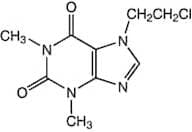
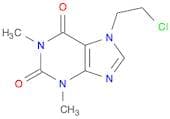
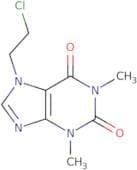
CAS 5878-61-5
:7-(2-Chloroethyl)theophylline
- 1H-Purine-2,6-dione, 7-(2-chloroethyl)-3,7-dihydro-1,3-dimethyl-
- 7-(2-Chloroethyl)-1,3-dimethyl-2,6(1H,3H)-purinedione
- 7-(2-Chloroethyl)-1,3-dimethylxanthine
- 7-(2-Chloroethyl)-3,7-dihydro-1,3-dimethyl-1H-purine-2,6-dione
- 7-(2-chloroethyl)-1,3-dimethyl-3,7-dihydro-1H-purine-2,6-dione
- 7-(Chloroethyl)theophylline
- 7-(β-Chlorethyl)theophylline
- 7-(β-Chloroethyl)theophylline
- Benaphyllin
- Benaphylline
- Eupnophile
- NSC 337614
- Theophylline, 7-(2-chloroethyl)-
- β-Chloroethyltheophylline
- See more synonyms
7-(2-Chloroethyl)theophylline, 97%
CAS:An adenosine receptor antagonistFormula:C9H11ClN4O2Purity:97%Color and Shape:Powder, WhiteMolecular weight:242.661H-Purine-2,6-dione,7-(2-chloroethyl)-3,7-dihydro-1,3-dimethyl-
CAS:Formula:C9H11ClN4O2Purity:97%Color and Shape:SolidMolecular weight:242.66227-(2-Chloroethyl)-1,3-Dimethyl-1H-Purine-2,6(3H,7H)-Dione
CAS:7-(2-Chloroethyl)-1,3-Dimethyl-1H-Purine-2,6(3H,7H)-DionePurity:98%Molecular weight:242.66g/mol7-(β-CHLOROETHYL)THEOPHYLLINE
CAS:Formula:C9H11ClN4O2Purity:95.0%Color and Shape:SolidMolecular weight:242.667-(2-Chloroethyl)theophylline
CAS:Controlled ProductApplications 7-(2-Chloroethyl)theophylline (cas# 5878-61-5) is a useful research chemical.
Formula:C9H11N4O2ClColor and Shape:NeatMolecular weight:242.667-(2-Chloroethyl)theophylline
CAS:Controlled Product7-(2-Chloroethyl)theophylline is a drug that is used as a stimulant, depressant, and in some cases to treat asthma. It is an analog of theophylline (a methylxanthine), but with a chlorine atom attached to the 2-position. 7-(2-Chloroethyl)theophylline binds to adenosine receptors, which are found in the central nervous system and play an important role in regulating sleep and wakefulness. Chronic treatment with this drug leads to changes in the distribution of adenosine receptors in the brain. This leads to increased levels of adenosinergic neurotransmitters such as dopamine and serotonin, which may result in beneficial effects on mood disorders such as depression or anxiety. The more potent stimulant properties of 7-(2-Chloroethyl)theophylline are due to its ability to bind to other receptor sites, such as those for dopamine and norepinephrine.
Formula:C9H11ClN4O2Purity:Min. 95%Molecular weight:242.66 g/mol