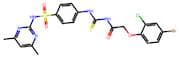
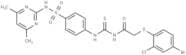
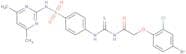
CAS 587841-73-4
:ZCL278
Description:
ZCL278, with the CAS number 587841-73-4, is a chemical compound that functions primarily as a selective inhibitor of the protein kinase CK2 (casein kinase 2). This compound is characterized by its ability to modulate various cellular processes, including cell proliferation and survival, making it of interest in cancer research and other therapeutic applications. ZCL278 exhibits a relatively high specificity for CK2, which is crucial for minimizing off-target effects in biological systems. The compound is typically studied in the context of its biochemical properties, including its solubility, stability, and interaction with biological macromolecules. Additionally, ZCL278 has been evaluated for its potential effects on signaling pathways and its role in the regulation of gene expression. As with many small molecule inhibitors, understanding its pharmacokinetics and pharmacodynamics is essential for assessing its viability as a therapeutic agent. Overall, ZCL278 represents a valuable tool in the exploration of CK2's role in various diseases, particularly in oncology.
- 2-(4-broMo-2-chlorophenoxy)-N-(4-(N-(4,6-diMethylpyriMidin-2-yl)sulfaMoyl)phenylcarbaMothioyl)acetaMide
Sort by
Purity (%)
0
100
|
0
|
50
|
90
|
95
|
100
Found 4 products.
ZCL278
CAS:ZCL278 is a selective Cdc42 GTPase inhibitor.Formula:C21H19BrClN5O4S2Purity:96.29% - 99.72%Color and Shape:SolidMolecular weight:584.89Ref: TM-T1855
5mg50.00€10mg79.00€25mg136.00€50mg221.00€100mg310.00€200mg497.00€500mg805.00€1mL*10mM (DMSO)79.00€2-(4-broMo-2-chlorophenoxy)-N-(4-(N-(4,6-diMethylpyriMidin-2-yl)sulfaMoyl)phenylcarbaMothioyl)acetaMide
CAS:Purity:98%Molecular weight:584.8900146ZCL 278
CAS:ZCL 278 is a molecule that has been shown in animal models to inhibit the growth of prostate cancer cells. It has also been shown to be effective against other types of cancer, including breast and colorectal cancers. ZCL 278 is thought to work by inhibiting protein transport on the cell surface and preventing cells from proliferating. This drug is still undergoing clinical trials and its effects on humans are unknown. It is not known how ZCL 278 works in molecular terms or what it will do to the cerebellar granule neurons. It is also not known if this molecule can be used as a treatment for neurodegenerative diseases such as Alzheimer's disease or Parkinson's disease.Formula:C21H19BrClN5O4S2Purity:Min. 95%Molecular weight:584.89 g/mol