


CAS 58822-25-6
:(5-leucine)enkephalin
Description:
(5-Leucine)enkephalin, also known as Leu-enkephalin, is a pentapeptide that belongs to the class of endogenous opioid peptides. It is composed of five amino acids, specifically Tyr-Gly-Gly-Phe-Leu, and is primarily involved in modulating pain, stress, and emotional responses in the body. This peptide acts as a ligand for opioid receptors, particularly the delta and mu receptors, which are crucial for mediating analgesic effects. Leu-enkephalin is synthesized in the central nervous system and adrenal medulla and plays a significant role in the body's natural pain relief mechanisms. Its structure features a C-terminal leucine residue, which is essential for its binding affinity and biological activity. The substance is known for its neuroprotective properties and potential therapeutic applications in pain management and mood disorders. Additionally, it is subject to enzymatic degradation, which influences its duration of action in physiological processes. Overall, (5-leucine)enkephalin is a vital component of the body's endogenous opioid system, contributing to various physiological functions.
Formula:C28H37N5O7
InChI:InChI=1/C28H37N5O7/c1-17(2)12-23(28(39)40)33-27(38)22(14-18-6-4-3-5-7-18)32-25(36)16-30-24(35)15-31-26(37)21(29)13-19-8-10-20(34)11-9-19/h3-11,17,21-23,34H,12-16,29H2,1-2H3,(H,30,35)(H,31,37)(H,32,36)(H,33,38)(H,39,40)/t21-,22-,23-/m0/s1
SMILES:CC(C)C[C@@H](C(=O)O)N=C([C@H](Cc1ccccc1)N=C(CN=C(CN=C([C@H](Cc1ccc(cc1)O)N)O)O)O)O
Synonyms:- Leu-Enkephalin
- Leu5-Enkephalin
- Tyrosylglycylglycylphenylalanylleucine
- L-tyrosylglycylglycyl-L-phenylalanyl-L-leucine
- 152: PN: US20030176421 PAGE: 54-55 claimed protein
- 1-5-Dynorphin
- 1-5-β-Neoendorphin (human)
- 2: PN: WO2008052043 SEQID: 1 claimed protein
- 26: PN: WO2005095443 SEQID: 26 claimed protein
- 4: PN: US20060040879 SEQID: 4 claimed protein
- 5-L-Leucine-enkephalin
- 693: PN: WO2004005342 PAGE: 46 claimed protein
- 9: PN: WO2008008805 SEQID: 9 unclaimed protein
- Dynorphin-(1-5)
- Enkephalin, leucine
- Ici 114740
- Leucine enkephalin
- Leucyl-enkephalin
- L-Leucine, L-tyrosylglycylglycyl-L-phenylalanyl-
- L-Leucine, N-[N-[N-(N-L-tyrosylglycyl)glycyl]-L-phenylalanyl]-
- L-Leucine-enkephalin
- L-Tyrosinylglycylglycyl-L-phenylalanyl-L-leucine
- N-[N-[N-(N-L-tirosilglicil)glicil]-L-fenilalanil]-L-leucina
- N-[N-[N-(N-L-Tyrosylglycyl)glycyl]-L-phenylalanyl]-L-leucin
- N-[N-[N-(N-L-tyrosylglycyl)glycyl]-L-phenylalanyl]-L-leucine
- Nsc 350588
- See more synonyms
Sort by
Purity (%)
0
100
|
0
|
50
|
90
|
95
|
100
Found 7 products.
Leu-Enkephalin
CAS:N-terminal sequence of dynorphin A and the neoendorphins.Formula:C28H37N5O7Purity:98.6%Color and Shape:WhiteMolecular weight:555.63[Leu5]-Enkephalin
CAS:[Leu5]-Enkephalin (Leu-enkephalin) is an endogenous neuropeptide involved in nociception and an agonist of δ-opioid and μ-opioid receptors (Kis = 4.0 and 3.4 nMFormula:C28H37N5O7Purity:99.87% - 99.88%Color and Shape:SolidMolecular weight:555.62Leucine-Enkephalin
CAS:Leucine-Enkephalin is a research tool that binds to the opioid receptor. It is an activator of the receptor and can be used in cell biology, pharmacology, and as a ligand or antibody for receptor studies. Leucine-Enkephalin has been shown to inhibit ion channels in vitro and can be used to study protein interactions. This peptide also exhibits pharmacological effects in vivo, including analgesia, inhibition of gastrointestinal motility, and induction of emesis.Formula:C28H37N5O7Purity:Min. 95%Molecular weight:555.62 g/molLeucine-Enkephalin (Human, Porcine, Bovine, Rat, Mouse)
CAS:Leucine-Enkephalin is a peptide that is composed of the amino acids leucine and enkephalin. It functions as an endogenous opioid with effects on the brain that include analgesia, sedation, and appetite suppression. Leucine-Enkephalin stimulates κ-opioid receptors in the brain and has been shown to reduce neuronal death caused by energy metabolism deficiency or cerebral ischemia. This peptide also causes autophagy and neurokinin-1 receptor activation, which can lead to significant interactions with physiological effects such as symptoms of anxiety, depression, or addiction.Formula:C28H37N5O7•H2OPurity:Min. 95%Molecular weight:573.64 g/mol
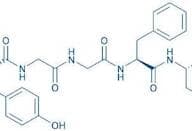

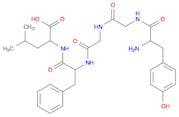

![[Leu5]-Enkephalin](/_next/image/?url=https%3A%2Fstatic.cymitquimica.com%2Fproducts%2F54%2Fthumb%2FBUP11200.jpg&w=3840&q=75)

![[Leu5]-Enkephalin](/_next/image/?url=https%3A%2Fstatic.cymitquimica.com%2Fproducts%2FTM%2Fthumb%2FT7173.jpg&w=3840&q=75)


![[Leu5]-Enkephalin](/_next/image/?url=https%3A%2Fstatic.cymitquimica.com%2Fproducts%2FST-EA%2Fthumb%2FEA-CP-L28019.jpg&w=3840&q=75)
