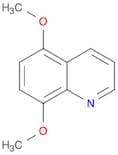
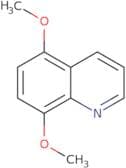
CAS 58868-41-0
:5,8-dimethoxyquinoline
Description:
5,8-Dimethoxyquinoline is an organic compound characterized by its quinoline structure, which consists of a fused benzene and pyridine ring. The presence of two methoxy groups (-OCH3) at the 5 and 8 positions of the quinoline ring significantly influences its chemical properties and reactivity. This compound typically appears as a yellow to brown solid and is sparingly soluble in water but more soluble in organic solvents such as ethanol and dichloromethane. 5,8-Dimethoxyquinoline may exhibit biological activity, making it of interest in medicinal chemistry and pharmacology. Its structure allows for potential interactions with various biological targets, which can be explored for therapeutic applications. Additionally, the methoxy substituents can enhance the compound's lipophilicity, affecting its absorption and distribution in biological systems. As with many quinoline derivatives, it may also possess fluorescent properties, which can be useful in analytical applications. Safety data should be consulted for handling and usage, as with all chemical substances.
Formula:C11H11NO2
InChI:InChI=1/C11H11NO2/c1-13-9-5-6-10(14-2)11-8(9)4-3-7-12-11/h3-7H,1-2H3
Sort by
Purity (%)
0
100
|
0
|
50
|
90
|
95
|
100
Found 3 products.
5,8-dimethoxyquinoline
CAS:5,8-dimethoxyquinoline is a nitrate that is used in the synthesis of heterocyclic compounds. It can be prepared by alkylation of 5,8-dimethoxybenzaldehyde with methyl iodide and sodium nitrite in the presence of ethanol or by the reaction of 2-nitropropane with benzaldehyde. The n-oxide of this compound has been shown to have activity against solid tumours and human lung carcinoma cell lines. 5,8-Dimethoxyquinoline reacts with dimethylhydrazone to form an unstable carbonyl intermediate which undergoes a 1,2-shift in nmr chemical shift.Formula:C11H11NO2Purity:Min. 95%Molecular weight:189.21 g/mol