CAS 59020-10-9
:3-(Tributylstannyl)-pyridine
Description:
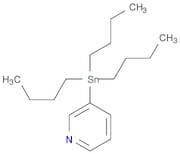
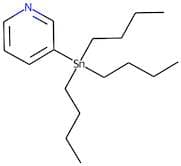
3-(Tributylstannyl)-pyridine is an organotin compound characterized by the presence of a pyridine ring substituted with a tributylstannyl group. The molecular structure features a pyridine moiety, which is a six-membered aromatic ring containing one nitrogen atom, and is attached to a tributylstannyl group, consisting of a tin atom bonded to three butyl groups. This compound is typically a colorless to pale yellow liquid and is known for its applications in organic synthesis and as a reagent in various chemical reactions. The presence of the tin atom imparts unique properties, such as enhanced reactivity and the ability to form organometallic complexes. Additionally, the tributylstannyl group can influence the solubility and stability of the compound in different solvents. However, organotin compounds are subject to environmental regulations due to their potential toxicity and bioaccumulation. As with many organometallic compounds, proper handling and disposal are essential to mitigate any environmental impact.
Formula:C17H31NSn
InChI:InChI=1/C5H4N.3C4H9.Sn/c1-2-4-6-5-3-1;3*1-3-4-2;/h1-2,4-5H;3*1,3-4H2,2H3;/rC17H31NSn/c1-4-7-13-19(14-8-5-2,15-9-6-3)17-11-10-12-18-16-17/h10-12,16H,4-9,13-15H2,1-3H3
SMILES:CCCC[Sn](CCCC)(CCCC)c1cccnc1
Synonyms:- 3-(1,1,1-Tributylstannyl)pyridine
- 3-Pyridyltri-N-Butyltin
- 3-(Tributylstannanyl)Pyridine
Sort by
Purity (%)
0
100
|
0
|
50
|
90
|
95
|
100
Found 3 products.
3-(Tributylstannyl)pyridine
CAS:Formula:C17H31NSnPurity:97%Color and Shape:LiquidMolecular weight:368.13573-Tris(but-1-ylstannyl)pyridine
CAS:3-Tris(but-1-ylstannyl)pyridineFormula:C17H31NSnPurity:≥95%Color and Shape: dark brown liquidMolecular weight:368.14g/mol3-(Tributylstannyl)pyridine
CAS:Controlled Product3-Tributylstannylpyridine (3-TBS) is a synthetic compound that is used in cross-coupling reactions to form carbon-carbon bonds. It reacts with unsaturated compounds and halides, providing nitrogen atoms in the final product. 3-TBS can be used for the synthesis of quinoxalines, which are chemical compounds that have been shown to have anti-inflammatory properties. The reaction of 3-TBS with chlorobenzene and chloride yields a phosphine and a tetrahydropyridine, which can be oxidized to form an N-(2,4,6-trichlorophenyl)pyridinium salt. This salt has been shown to have anti-inflammatory effects by inhibiting prostaglandin synthesis.
Formula:C17H31NSnPurity:Min. 95%Molecular weight:368.15 g/mol