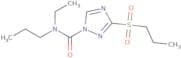
CAS 59026-08-3
:N-ethyl-N-propyl-3-(propylsulfonyl)-1H-1,2,4-triazole-1-carboxamide
Description:
N-ethyl-N-propyl-3-(propylsulfonyl)-1H-1,2,4-triazole-1-carboxamide, identified by its CAS number 59026-08-3, is a chemical compound that belongs to the class of triazole derivatives. This compound features a triazole ring, which is a five-membered heterocyclic structure containing three nitrogen atoms, contributing to its biological activity. The presence of the carboxamide functional group enhances its solubility and potential interactions with biological targets. The propylsulfonyl group is significant for its role in modulating the compound's pharmacological properties, possibly influencing its efficacy and selectivity. This compound is of interest in various fields, including agricultural chemistry and pharmaceuticals, particularly for its potential use as a fungicide or in other therapeutic applications. Its molecular structure suggests it may exhibit specific interactions with enzymes or receptors, making it a candidate for further research in drug development. As with many chemical substances, safety and handling precautions are essential due to potential toxicity or environmental impact.
Formula:C11H20N4O3S
InChI:InChI=1/C11H20N4O3S/c1-4-7-14(6-3)11(16)15-9-12-10(13-15)19(17,18)8-5-2/h9H,4-8H2,1-3H3
SMILES:CCCN(CC)C(=O)n1cnc(n1)S(=O)(=O)CCC
Synonyms:- 1-(N-Ethyl-N-propylcarbamoyl)-3-propylsulfonyl-1H-1,2,4-triazole
- 1H-1,2,4-triazole-1-carboxamide, N-ethyl-N-propyl-3-(propylsulfonyl)-
- Epronaz
- N-Ethyl-N-propyl-3-(propylsulfonyl)-1H-1,2,4-triazol-1-carboxamid
Sort by
Purity (%)
0
100
|
0
|
50
|
90
|
95
|
100
Found 1 products.
Epronaz
CAS:Epronaz is an analog of a naturally occurring human metabolite found in urine that has been shown to exhibit anticancer properties. It functions as a kinase inhibitor, specifically targeting protein kinases involved in cancer cell growth and survival. Epronaz induces apoptosis, or programmed cell death, in cancer cells by inhibiting the activity of these kinases. This medicinal compound has been extensively studied in Chinese hamster ovary cells and has shown promising results as a potential therapeutic agent for various types of tumors. Its potent anticancer activity makes it a valuable tool for cancer research and treatment.
Formula:C11H20N4O3SPurity:Min. 95%Molecular weight:288.37 g/mol