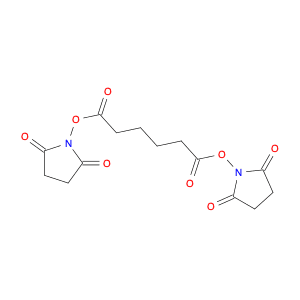
![2,5-Pyrrolidinedione, 1,1'-[(1,6-dioxo-1,6-hexanediyl)bis(oxy)]bis-](/_next/image/?url=https%3A%2Fstatic.cymitquimica.com%2Fcas-image%2Fthumb-webp%2F318969-25-pyrrolidinedione-11-16-dioxo-16-hexanediyl-bis-oxy-bis.webp&w=3840&q=75)
CAS 59156-70-6
:2,5-Pyrrolidinedione, 1,1'-[(1,6-dioxo-1,6-hexanediyl)bis(oxy)]bis-
Description:
2,5-Pyrrolidinedione, 1,1'-[(1,6-dioxo-1,6-hexanediyl)bis(oxy)]bis-, commonly referred to as a derivative of pyrrolidinedione, is a chemical compound characterized by its cyclic structure and the presence of multiple functional groups. This substance features a pyrrolidine ring, which contributes to its stability and reactivity. The compound contains dioxo and ether linkages, indicating potential for hydrogen bonding and solubility in polar solvents. Its molecular structure suggests it may exhibit properties typical of diketones and polyethers, which can influence its reactivity in various chemical reactions, including condensation and polymerization. The presence of the hexanediyl moiety indicates a relatively long carbon chain, which may affect its physical properties, such as melting and boiling points, as well as its solubility profile. Additionally, this compound may have applications in materials science, particularly in the synthesis of polymers or as a precursor in organic synthesis due to its functional versatility. Safety data should be consulted for handling and usage, as with any chemical substance.
Formula:C14H16N2O8
Sort by
Purity (%)
0
100
|
0
|
50
|
90
|
95
|
100
Found 6 products.
Di(N-succinimidyl) adipate
CAS:Formula:C14H16N2O8Purity:95%Color and Shape:SolidMolecular weight:340.2854Bis(2,5-Dioxopyrrolidin-1-Yl) Adipate
CAS:Bis(2,5-Dioxopyrrolidin-1-Yl) AdipatePurity:97%Molecular weight:340.29g/molDi(N-succinimidyl)adipate
CAS:Di(N-succinimidyl)adipate, an alkyl chain-based PROTAC linker, facilitates the synthesis of PROTACs[1].Formula:C14H16N2O8Color and Shape:SolidMolecular weight:340.29Di(N-succinimidyl) adipate
CAS:Di(N-succinimidyl) adipate is a conjugate that contains the active ester group. It can be used for labelling biomolecules, such as proteins and glycoconjugates. Di(N-succinimidyl) adipate has been shown to be used in cryo-electron microscopy, which is an imaging technique that allows the visualization of structures at a molecular level. This compound also has been shown to be used as a model for sulfatide in the brain and repair mechanisms of the central nervous system. Immunological studies using this molecule have been conducted on meningitis bacteria and it has also been used for vaccine development.Formula:C14H16N2O8Purity:Min. 95%Color and Shape:White PowderMolecular weight:340.29 g/mol