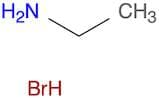
CAS 593-55-5
:Ethanamine, hydrobromide (1:1)
Description:
Ethanamine, hydrobromide (1:1), also known as ethylamine hydrobromide, is an organic compound characterized by its amine functional group and the presence of a hydrobromide salt. It is typically a white crystalline solid that is soluble in water and polar solvents, reflecting its ionic nature due to the presence of the hydrobromide. The compound is derived from ethylamine, which is a primary amine, and the hydrobromide form indicates that it is protonated, enhancing its solubility and reactivity. Ethanamine, hydrobromide is often used in organic synthesis and as a reagent in various chemical reactions, including the preparation of pharmaceuticals and agrochemicals. It exhibits basic properties typical of amines and can participate in nucleophilic substitution reactions. Safety precautions should be observed when handling this compound, as it may cause irritation to the skin, eyes, and respiratory system. Proper storage in a cool, dry place away from incompatible substances is recommended to maintain its stability and efficacy.
Formula:C2H7N·BrH
InChI:InChI=1S/C2H7N.BrH/c1-2-3;/h2-3H2,1H3;1H
InChI key:InChIKey=PNZDZRMOBIIQTC-UHFFFAOYSA-N
SMILES:C(C)N.Br
Synonyms:- Ethanamine Hydrobromide (1:1)
- Ethanamine, hydrobromide
- Ethylamine monohydrobromide
- Ethylammonium bromide
- Ethylammoniumbromide
- Mono Ethylamine Hydrobromide
- Ethylamine, hydrobromide
Sort by
Purity (%)
0
100
|
0
|
50
|
90
|
95
|
100
Found 3 products.
Ethylamine Hydrobromide
CAS:Formula:C2H7N·HBrPurity:>98.0%(T)(N)Color and Shape:White to Almost white powder to crystalMolecular weight:126.00Ethylamine hydrobromide
CAS:Controlled ProductEthylamine hydrobromide is a chemical compound that is a surfactant and belongs to the group of p2 compounds. It has been shown to have light-emitting properties, which may be due to its ability to form bound forms in solution. The basic structure of ethylamine hydrobromide consists of nitrogen atoms that are arranged in a tetrahedral configuration with four hydrogen atoms bonded to each atom. Ethylamine hydrobromide can also act as an agonist of various receptors found on the surface of cells, including the receptor activity for colony-stimulating factor (CSF). Ethylamine hydrobromide has been shown to have physiological effects on cells, such as increasing the cell count in cultures and activating CSF production by cells. This chemical also has surfactant properties, which may be due to its ability to bind hydrophobic substances by coating them and lowering their surface tension. Ethylamine hydrobromidePurity:Min. 95%