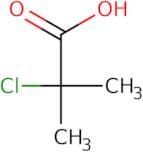
CAS 594-58-1
:2-Chloro-2-methylpropanoic acid
Description:
2-Chloro-2-methylpropanoic acid, also known as chloroisobutyric acid, is a colorless to pale yellow liquid with a pungent odor. It is classified as a carboxylic acid due to the presence of a carboxyl functional group (-COOH). The compound features a chlorine atom and a methyl group attached to the second carbon of a three-carbon backbone, contributing to its unique properties. It is soluble in water and organic solvents, making it versatile for various applications. This substance is primarily used in organic synthesis, particularly in the production of herbicides and pharmaceuticals. It exhibits moderate toxicity and can cause irritation to the skin, eyes, and respiratory system upon exposure. Proper safety precautions should be taken when handling this chemical, including the use of personal protective equipment. Additionally, it is important to store it in a cool, well-ventilated area away from incompatible substances. Overall, 2-chloro-2-methylpropanoic acid is a significant compound in chemical research and industrial applications.
Formula:C4H7ClO2
InChI:InChI=1S/C4H7ClO2/c1-4(2,5)3(6)7/h1-2H3,(H,6,7)
InChI key:InChIKey=MYCXCBCDXVFXNE-UHFFFAOYSA-N
SMILES:C(C(O)=O)(C)(C)Cl
Synonyms:- 2-Chloro isobutyric acid
- 2-Chloro-2-methylpropanoic acid
- 2-Chloroisobutyric acid
- Propanoic acid, 2-chloro-2-methyl-
- Propionic acid, 2-chloro-2-methyl-
- α-Chloroisobutyric acid
- 2-Chloro-2-methylpropionic acid
Sort by
Purity (%)
0
100
|
0
|
50
|
90
|
95
|
100
Found 1 products.
2-Chloro-2-methylpropionic acid
CAS:2-Chloro-2-methylpropionic acid (MCPA) is a chemical compound that belongs to the group of organic compounds called acyl chlorides. It is used in industry for the production of acrylic acid and polyacrylic acid, as well as in the production of herbicides. MCPA is produced by reacting an alkali metal with 2-chloroethanol and thioacetic acid. This reaction can be catalyzed by a variety of compounds, including palladium chloride, nickel chloride, and titanium tetrachloride. The high yield of this reaction makes it suitable for commercial use. MCPA also has been shown to stimulate cell growth through its inhibition of monomers from polymerization into polymers.
Formula:C4H7ClO2Purity:Min. 95%Color and Shape:PowderMolecular weight:122.55 g/mol