CAS 59551-02-9
:quinoline-5-carbonitrile
Description:
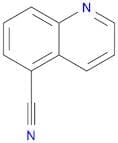
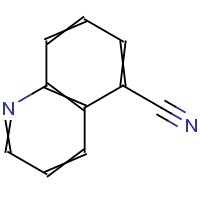
Quinoline-5-carbonitrile is an organic compound characterized by its quinoline backbone, which consists of a fused bicyclic structure containing a benzene ring and a pyridine ring. The presence of a cyano group (-C≡N) at the 5-position of the quinoline structure contributes to its chemical reactivity and potential applications. This compound typically appears as a solid and is known for its aromatic properties, which can influence its solubility and interaction with other substances. Quinoline derivatives, including quinoline-5-carbonitrile, are of interest in various fields such as medicinal chemistry, where they may exhibit biological activity, and in materials science for their potential use in organic electronics. The compound's reactivity can be attributed to the electron-withdrawing nature of the cyano group, which can enhance electrophilic substitution reactions. Additionally, quinoline-5-carbonitrile may serve as a precursor for synthesizing more complex molecules, making it valuable in synthetic organic chemistry. Safety data should be consulted for handling and storage, as with all chemical substances.
Formula:C10H6N2
InChI:InChI=1/C10H6N2/c11-7-8-3-1-5-10-9(8)4-2-6-12-10/h1-6H
SMILES:c1cc(C#N)c2cccnc2c1
Synonyms:- 5-Cyanoquinoline
Sort by
Purity (%)
0
100
|
0
|
50
|
90
|
95
|
100
Found 4 products.
Quinoline-5-carbonitrile
CAS:Quinoline-5-carbonitrile is a cyanide compound that can be used in the synthesis of heterocyclic compounds. The reaction between quinoline and 5-cyanovaleric acid produces 6-nitroquinoline, which is then converted to dimethyl sulfoxide by alcoholysis. This reaction product can then be used to synthesize an amide or nucleophile. Quinoline-5-carbonitrile reacts with potassium in the presence of bifunctional hydrazide to produce a cyanide ion, which can be hydrolyzed by an acid to release hydrogen cyanide gas. This experiment has been shown as a model for reactions involving cyano compounds.
Formula:C10H6N2Purity:Min. 95%Molecular weight:154.17 g/mol