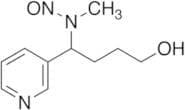
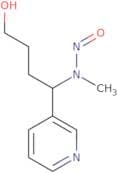
![4-[methyl(nitroso)amino]-4-(pyridin-3-yl)butan-1-ol](/_next/image/?url=https%3A%2Fstatic.cymitquimica.com%2Fcas-image%2Fthumb-webp%2F227350-4-methyl-nitroso-amino-4-pyridin-3-yl-butan-1-ol.webp&w=3840&q=75)
CAS 59578-66-4
:4-[methyl(nitroso)amino]-4-(pyridin-3-yl)butan-1-ol
Description:
4-[Methyl(nitroso)amino]-4-(pyridin-3-yl)butan-1-ol, with the CAS number 59578-66-4, is a chemical compound that features a complex structure incorporating a pyridine ring and a nitroso group. This compound is characterized by its functional groups, including an alcohol (-OH) and a nitroso (-N=O) moiety, which contribute to its reactivity and potential biological activity. The presence of the pyridine ring suggests that it may exhibit aromatic properties, influencing its solubility and interaction with other molecules. The methyl(nitroso)amino group indicates that it may participate in various chemical reactions, including nucleophilic substitutions and redox reactions. Additionally, the compound's structure suggests potential applications in medicinal chemistry, particularly in the development of pharmaceuticals or agrochemicals. However, the specific biological effects, toxicity, and environmental impact of this compound would require further investigation through experimental studies and toxicological assessments. Overall, its unique structural features make it a subject of interest in both synthetic and applied chemistry.
Formula:C10H15N3O2
InChI:InChI=1/C10H15N3O2/c1-13(12-15)10(5-3-7-14)9-4-2-6-11-8-9/h2,4,6,8,10,14H,3,5,7H2,1H3
SMILES:CN(C(CCCO)c1cccnc1)N=O
Synonyms:- 3-Pyridinebutanol, Delta-(Methylnitrosoamino)-
- 4-[Methyl(nitroso)amino]-4-(pyridin-3-yl)butan-1-ol
Sort by
Purity (%)
0
100
|
0
|
50
|
90
|
95
|
100
Found 4 products.
4-(N-Methyl-N-nitrosamino)-4-(3-pyridyl)butane-1-ol
CAS:Controlled ProductFormula:C10H15N3O2Color and Shape:NeatMolecular weight:209.244-(N-Methyl-N-nitrosamino)-4-(3-pyridyl)butane-1-ol
CAS:4-(N-Methyl-N-nitrosamino)-4-(3-pyridyl)butane-1-ol is a chemical that can be found in tobacco smoke. It has been shown that chronic exposure to 4-(N-methyl-N-nitrosamino)-4-(3-pyridyl)butane-1-ol causes cancer in rodents, as evidenced by increased rates of tumorigenesis. This chemical also has the ability to inhibit butyric acid formation, which may reduce the risk of colon cancer. The carcinogenic effect of this chemical is due to its ability to react with DNA and form adducts that cause methylation at C8 position on guanine nucleotide (G). These adducts lead to mutations, which can lead to cancer.Formula:C10H15N3O2Purity:Min. 95%Molecular weight:209.25 g/mol