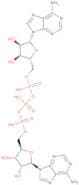
CAS 5959-90-0
:Ap3A
Description:
Ap3A, or adenosine 5'-triphosphate (ATP) derivative, is a nucleotide compound characterized by its structure, which includes a ribose sugar, adenine base, and a triphosphate group. The CAS number 5959-90-0 specifically identifies this compound, which is known for its role in biochemical processes, particularly in cellular energy transfer and signaling. Ap3A is recognized for its ability to act as a signaling molecule, influencing various physiological processes, including cell proliferation and differentiation. It is often studied in the context of its interactions with enzymes and receptors, contributing to our understanding of cellular communication. Additionally, Ap3A can serve as a substrate for certain kinases and is involved in the regulation of metabolic pathways. Its stability and reactivity are influenced by the presence of the phosphate groups, which can undergo hydrolysis, releasing energy that is crucial for many biological functions. Overall, Ap3A is an important compound in biochemistry, with implications in both fundamental research and potential therapeutic applications.
Formula:C20H27N10O16P3
InChI:InChI=1S/C20H27N10O16P3/c21-15-9-17(25-3-23-15)29(5-27-9)19-13(33)11(31)7(43-19)1-41-47(35,36)45-49(39,40)46-48(37,38)42-2-8-12(32)14(34)20(44-8)30-6-28-10-16(22)24-4-26-18(10)30/h3-8,11-14,19-20,31-34H,1-2H2,(H,35,36)(H,37,38)(H,39,40)(H2,21,23,25)(H2,22,24,26)/t7-,8-,11-,12-,13-,14-,19-,20-/m1/s1
InChI key:InChIKey=QCICUPZZLIQAPA-XPWFQUROSA-N
SMILES:O[C@H]1[C@H](N2C=3C(N=C2)=C(N)N=CN3)O[C@H](COP(OP(OP(OC[C@H]4O[C@H]([C@H](O)[C@@H]4O)N5C=6C(N=C5)=C(N)N=CN6)(=O)O)(=O)O)(=O)O)[C@H]1O
Synonyms:- Adenosine 5′-(tetrahydrogen triphosphate), P′′→5′-ester with adenosine
- ApppA
- Adenosine 5′-triphosphate, 5′-ester with adenosine
- P1,P3-Diadenosine-5′ triphosphate
- Ap3A
Sort by
Purity (%)
0
100
|
0
|
50
|
90
|
95
|
100
Found 2 products.
P1-(5'-Adenosyl) P3-(5'-adenosyl) triphosphate sodium salt
CAS:P1-(5'-Adenosyl) P3-(5'-adenosyl) triphosphate sodium salt is an intermediate in the biosynthesis of ATP. It is also a cofactor for adenylate kinase and pyruvate kinase. The synthesis of this compound takes place in human serum and requires the enzyme synthetase as well as sephadex g-100. Synthetase catalyzes the condensation of ATP with 5-AMP to yield P1-(5'-adenosyl) P3-(5'-adenosyl) triphosphate sodium salt. This reaction is reversible, and can be catalyzed by phosphohydrolases that hydrolyze ATP to AMP and inorganic phosphate. The physiological function of this compound is not yet clear, but it has been shown to increase intracellular Ca2+ levels in cardiac cells, leading to congestive heart failure. This compound has low potency, so it does not have anyFormula:C20H27N10O16P3•(Na)xPurity:Min. 95 Area-%Color and Shape:PowderMolecular weight:756.41 g/molAdenosine-(5')-triphospho-(5')-adenosine
CAS:Controlled ProductFormula:C20H27N10O16P3Color and Shape:NeatMolecular weight:756.407