CAS 59734-91-7
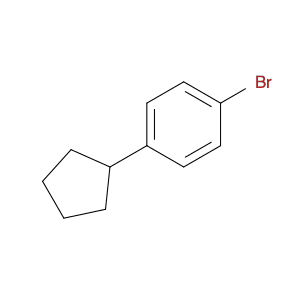
:1-Bromo-4-cyclopentylbenzene
Description:
1-Bromo-4-cyclopentylbenzene is an organic compound characterized by the presence of a bromine atom attached to a benzene ring that is also substituted with a cyclopentyl group at the para position. This compound belongs to the class of bromobenzenes and is notable for its unique structural features, which influence its chemical properties and reactivity. It typically appears as a colorless to pale yellow liquid and has a relatively low solubility in water, making it more soluble in organic solvents. The presence of the bromine atom introduces a degree of electrophilicity, which can facilitate various substitution reactions. Additionally, the cyclopentyl group contributes to the compound's steric and electronic characteristics, potentially affecting its interactions in chemical reactions and its behavior in biological systems. 1-Bromo-4-cyclopentylbenzene is utilized in organic synthesis and may serve as an intermediate in the production of more complex molecules. Safety precautions should be observed when handling this compound due to the presence of bromine, which can be hazardous.
Formula:C11H13Br
InChI:InChI=1S/C11H13Br/c12-11-7-5-10(6-8-11)9-3-1-2-4-9/h5-9H,1-4H2
InChI key:InChIKey=NVJMEQDYMUAAKL-UHFFFAOYSA-N
SMILES:BrC1=CC=C(C=C1)C2CCCC2
Synonyms:- 1-Bromo-4-cyclopentylbenzene
- p-Bromocyclopentylbenzene
- Benzene, 1-bromo-4-cyclopentyl-
Sort by
Purity (%)
0
100
|
0
|
50
|
90
|
95
|
100
Found 3 products.
1-Bromo-4-cyclopentylbenzene
CAS:1-Bromo-4-cyclopentylbenzene (1-BCPB) is a chlorinated aromatic compound that can be synthesized by reacting 1-bromo-4-chlorobenzene and cyclopentylmagnesium bromide. The reaction sequence begins with the addition of hydrochloric acid to the first reactant, followed by magnesium chloride and ether. The mixture is heated to produce a liquid solution of ethylhexyloxy pyridine, which reacts with the second reactant in a sequence that leads to the desired product. 1-BCPB is used as an intermediate in organic synthesis. It has been shown to have moderate interaction with paraldehyde and pyridinium salts at room temperature, but it does not react with cycloalkyls or pyridinium salts at elevated temperatures.
Formula:C11H13BrPurity:Min. 95%Molecular weight:225.13 g/mol