CAS 59834-05-8
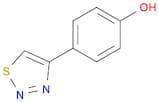
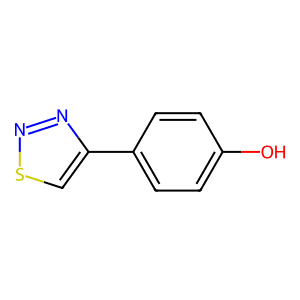
:4-(1,2,3-thiadiazol-4-yl)phenol
- Phenol, 4-(1,2,3-thiadiazol-4-yl)-
4-(1,2,3-Thiadiazol-4-yl)phenol
CAS:4-(1,2,3-Thiadiazol-4-yl)phenolFormula:C8H6N2OSPurity:95%Color and Shape: brown solidMolecular weight:178.21g/mol4-(1,2,3-Thiadiazol-4-yl)phenol
CAS:Formula:C8H6N2OSPurity:97%Color and Shape:SolidMolecular weight:178.214-(1,2,3-Thiadiazol-4-yl)phenol
CAS:4-(1,2,3-Thiadiazol-4-yl)phenol is an antibiotic that belongs to the group of antimicrobials. It has an inhibitory concentration (IC) of 0.5 micrograms/ml against pyogenic bacteria and 1.0 micrograms/ml against a number of other bacterial strains. 4-(1,2,3-Thiadiazol-4-yl)phenol also has antimicrobial properties against fungi and may be used for the treatment of catalase-producing bacteria such as Streptococcus pyogenes or Staphylococcus aureus. Elemental analysis revealed that this compound is composed entirely of carbon, hydrogen, and oxygen. The molecular weight was found to be 166.16 g/mol. This compound inhibits bacterial growth by binding to DNA-dependent RNA polymerase and preventing transcription and replication of DNA. This active form is metabolized through a number of metabolic transformations including hydro
Formula:C8H6N2OSPurity:Min. 95%Molecular weight:178.21 g/mol