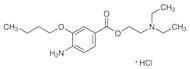
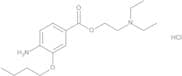
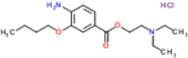
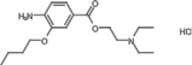
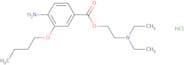
CAS 5987-82-6
:Oxybuprocaine hydrochloride
Description:
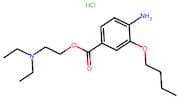
Oxybuprocaine hydrochloride, also known as proxymetacaine, is a local anesthetic belonging to the ester class of anesthetics. It is commonly used in ophthalmology for its ability to provide surface anesthesia during various eye procedures. The substance appears as a white to off-white crystalline powder and is soluble in water, which facilitates its application in aqueous solutions. Oxybuprocaine hydrochloride works by blocking sodium channels, thereby inhibiting the propagation of nerve impulses and resulting in a temporary loss of sensation in the targeted area. Its onset of action is relatively rapid, and the duration of anesthesia can vary depending on the concentration used and the specific application. The compound is generally well-tolerated, although potential side effects may include local irritation or allergic reactions. Due to its effectiveness and safety profile, oxybuprocaine hydrochloride is widely utilized in clinical settings, particularly for procedures involving the eye, such as tonometry and cataract surgery.
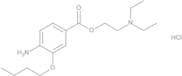
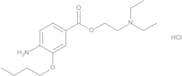
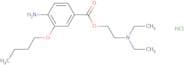
Formula:C17H28N2O3·ClH
InChI:InChI=1S/C17H28N2O3.ClH/c1-4-7-11-21-16-13-14(8-9-15(16)18)17(20)22-12-10-19(5-2)6-3;/h8-9,13H,4-7,10-12,18H2,1-3H3;1H
InChI key:InChIKey=PRGUDWLMFLCODA-UHFFFAOYSA-N
SMILES:C(OCCN(CC)CC)(=O)C1=CC(OCCCC)=C(N)C=C1.Cl
Synonyms:- 2-(Diethylamino)ethyl 4-amino-3-butoxybenzoate hydrochloride
- 2-[(4-amino-3-butoxybenzoyl)oxy]-N,N-diethylethanaminium chloride
- Benoxil
- Benoxinate Hcl
- Benzoic acid, 4-amino-3-butoxy-, 2-(diethylamino)ethyl ester, hydrochloride (1:1)
- Benzoic acid, 4-amino-3-butoxy-, 2-(diethylamino)ethyl ester, monohydrochloride
- Boxinate
- Cebesine
- Conjucaine
- Conjuncain
- Dorsacaine
- Dorsacaine hydrochloride
- Lacrimin
- Minims
- Novesin
- Novesine
- Oxybuprocaine HCL
- Oxybuprocaine hydrochloride
- See more synonyms
Sort by
Purity (%)
0
100
|
0
|
50
|
90
|
95
|
100
Found 15 products.
Oxybuprocaine Hydrochloride
CAS:Formula:C17H28N2O3·HClPurity:>98.0%(T)(HPLC)Color and Shape:White to Light yellow powder to crystalMolecular weight:344.88OXYBUPROCAINE HYDROCHLORIDE CRS
CAS:OXYBUPROCAINE HYDROCHLORIDE CRSFormula:C17H29ClN2O3Color and Shape:Added ModifiedMolecular weight:344.8768Oxybuprocaine hydrochloride
CAS:Oxybuprocaine hydrochlorideFormula:C17H28N2O3HClPurity:99.8%Color and Shape:WhiteMolecular weight:344.18667Benoxinate Hydrochloride
CAS:Aromatic amino-alcohol-phenols, aromatic amino-acid-phenols and other aromatic amino compounds with oxygen functionFormula:C17H28N2O3·HClColor and Shape:Off-White White PowderMolecular weight:308.20999Oxybuprocaine hydrochloride
CAS:Oxybuprocaine hydrochloride (Oxybuprocaine HCl), a local anesthetic, is used especially in otolaryngology and ophthalmology.Formula:C17H29ClN2O3Purity:>99.99%Color and Shape:White Crystalline PowderMolecular weight:344.88Benoxinate hydrochloride
CAS:Formula:C17H29ClN2O3Color and Shape:White to off-white powder or crystalsMolecular weight:344.88Oxybuprocaine Hydrochloride
CAS:Controlled ProductFormula:C17H28N2O3·ClHColor and Shape:NeatMolecular weight:344.88Benoxinate Hydrochloride
CAS:Controlled ProductApplications Benoxinate is a local anesthetic used in ophthalmology to numb the surface of the eye for a variety of procedures.
References Ogbuehi, K.C., et al.: Clin. Ophthalmol., 6, 871 (2012); Hung, C.H., et al.: Anesthesia. Anal., 110, 238 (2009); Schmidt, A.C., et al.: Pharma. Res., 22, 2121 (2005);Formula:C17H28N2O3·ClHColor and Shape:NeatMolecular weight:344.88Oxybuprocaine hydrochloride
CAS:Controlled ProductOxybuprocaine hydrochloride is a local anesthetic that belongs to the group of x-ray diffraction data. It is a chemical compound that has been shown to be effective in inducing anesthesia in humans. Oxybuprocaine hydrochloride binds to proteins, such as benzalkonium chloride, and inhibits cell growth. It also has an anti-inflammatory effect by preventing the release of prostaglandins. Oxybuprocaine hydrochloride stabilizes chemical bonds and does not react with oxygen or water, making it a suitable candidate for use in eye drops and other solutions for application to skin cells. As well as this, oxybuprocaine hydrochloride can be used as a contrast agent for x-rays when dissolved in human serum or nutrient solution and can be detected using an electrochemical detector.Formula:C17H29ClN2O3Purity:Min. 95%Color and Shape:White PowderMolecular weight:344.88 g/mol2-(Diethylamino)ethyl 4-amino-3-butoxybenzoate hydrochloride
CAS:Formula:C17H29ClN2O3Purity:99+%Color and Shape:SolidMolecular weight:344.88Oxybuprocaine hydrochloride
CAS:Controlled ProductOxybuprocaine hydrochloride is a local anesthetic agent that blocks nerve conduction and inhibits the generation of action potentials. It has a high lipid solubility, which allows for rapid onset and short duration of action. Oxybuprocaine hydrochloride is used in the treatment of corneal ulcers, eye disorders, and other conditions where pain relief is desired. The safety and efficacy of oxybuprocaine hydrochloride has been studied in pregnant women, fetal bovine serum, and other animal models. In vitro studies demonstrated that it is chemically stable when exposed to benzalkonium chloride or benoxinate. Clinical relevance in humans has been established by demonstrating that human serum does not contain sufficient quantities of oxybuprocaine to cause toxicity.Formula:C17H29ClN2O3Purity:Min. 95%Molecular weight:344.88 g/mol