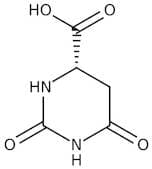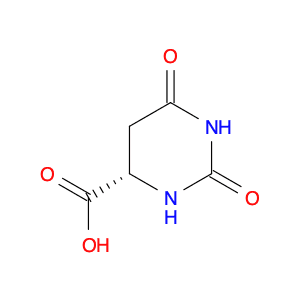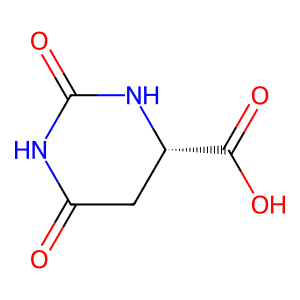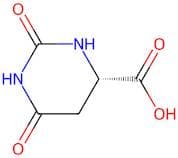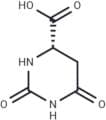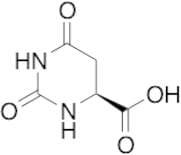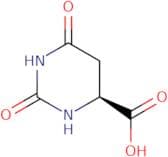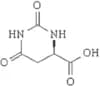
CAS 5988-19-2
:L-Dihydroorotic acid
Description:
L-Dihydroorotic acid, with the CAS number 5988-19-2, is a pyrimidine derivative that plays a crucial role in the biosynthesis of nucleotides, specifically in the de novo synthesis pathway of pyrimidines. It is a white to off-white crystalline solid that is soluble in water and exhibits a slightly acidic nature. The compound is characterized by its ability to undergo oxidation to form orotic acid, which is an important precursor in the synthesis of nucleic acids. L-Dihydroorotic acid is involved in various biological processes, including cellular metabolism and the regulation of cell growth. Its structural formula includes a dihydroorotic acid moiety, which features a pyrimidine ring with two carboxylic acid groups. This compound is of interest in pharmacology and biochemistry, particularly for its potential therapeutic applications in conditions related to nucleotide metabolism. Additionally, it serves as a substrate for enzymes such as dihydroorotate dehydrogenase, which is a target for certain anti-cancer and immunosuppressive drugs.
Formula:C5H6N2O4
InChI:InChI=1/C5H6N2O4/c8-3-1-2(4(9)10)6-5(11)7-3/h2H,1H2,(H,9,10)(H2,6,7,8,11)/t2-/m0/s1
InChI key:InChIKey=UFIVEPVSAGBUSI-REOHCLBHSA-N
SMILES:C(O)(=O)[C@@H]1CC(=O)NC(=O)N1
Synonyms:- (4S)-2,6-Dioxo-1,3-diazinane-4-carboxylic acid
- (4S)-Hexahydro-2,6-dioxo-4-pyrimidinecarboxylic acid
- (S)-2,6-Dioxohexahydropyrimidine-4-carboxylic acid
- 4-Pyrimidinecarboxylic acid, hexahydro-2,6-dioxo-, (4S)-
- 4-Pyrimidinecarboxylic acid, hexahydro-2,6-dioxo-, (S)-
- <span class="text-smallcaps">L</span>-5,6-Dihydroorotic acid
- <span class="text-smallcaps">L</span>-Dihydroorotate
- <span class="text-smallcaps">L</span>-Dihydroorotic acid
- Hydroorotic acid, <span class="text-smallcaps">L</span>-
- L-Dihydroorotic acid
- Hydroorotic acid, L-
- L-Dihydroorotate
- Adenosine-5'-diphosphoric acid Na2
- Guanosine-5-diphosphate disodiun
- 2,6-Dioxohexahydro-4-pyrimidinecarboxylic acid
- Guanosine-5-monophosphate disodiun
- Adenosine-5-triphosphoric acid Na2
- Deoxyribonucein acid(fish sperm)
- DIHYDRO-L-OROTIC ACID
- Guanosine-5'-triphosphate disodiun
- Inosine-5-triphosphate trisodium
- L-HYDROOROTIC ACID
- Ribonuclein acid,yeast
- (S)-2,6-Dioxohexahydro-4-pyrimidinecarboxylic acid
- (S)-(+)-HYDROOROTIC ACID
- L-4,5-Dihydroorotic acid~(S)-(+)-2,6-Dioxohexahydro-4-pyrimidinecarboxylic acid
- t-Ribonuclein acid,yeast
- (S)-Dihydroorotate
- See more synonyms
Sort by
Purity (%)
0
100
|
0
|
50
|
90
|
95
|
100
Found 9 products.
L-Dihydroorotic acid, 98%
CAS:L-Dihydroorotic acid a metabolite. This Thermo Scientific Chemicals brand product was originally part of the Alfa Aesar product portfolio. Some documentation and label information may refer to the legacy brand. The original Alfa Aesar product / item code or SKU reference has not changed as a part ofFormula:C5H6N2O4Purity:98%Molecular weight:158.11(4S)-2,6-dioxo-1,3-diazinane-4-carboxylic acid
CAS:Formula:C5H6N2O4Purity:98%Color and Shape:SolidMolecular weight:158.1121L-Dihydroorotic acid
CAS:L-Dihydroorotic acid, found in eukaryotes, is involved in pyrimidine metabolism and several disorders including orotic aciduria.Formula:C5H6N2O4Purity:99.88% - 99.93%Color and Shape:White To Off-White Crystalline PowderMolecular weight:158.11L-Dihydroorotic acid
CAS:Controlled ProductApplications L-Dihydroorotic acid is used as a reactant in the preparation of long acting Gonadotrophin-releasing hormone (GnRH) antagonist containing p-ureido-phenylalanine.
References Jiang, G., et al.: J. Med. Chem., 44, 453 (2001);Formula:C5H6N2O4Color and Shape:NeatMolecular weight:158.11L-Dihydroorotic acid
CAS:L-Dihydroorotic acid is a natural compound that can be found in plants, animals and humans. It has been shown to have an important role in mitochondrial functions, as it is involved in the synthesis of NADH and ATP. L-Dihydroorotic acid can also be used as a substrate for enzymatic reactions, such as dehydrogenase or dihydroorotate dehydrogenase. The rate constants for these reactions are high, which makes L-dihydroorotic acid a good model system for studying biochemical properties. L-dihydroorotic acid also inhibits cyclin D2/CDK4 protein kinases.Formula:C5H6N2O4Purity:Min. 95%Color and Shape:White PowderMolecular weight:158.11 g/mol