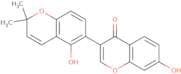
CAS 60008-02-8
:Glabrone
Description:
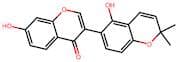
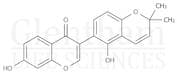
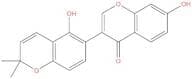
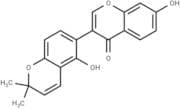
Glabrone, with the CAS number 60008-02-8, is a natural compound primarily derived from the roots of Glycyrrhiza glabra, commonly known as licorice. It belongs to the class of flavonoids and is characterized by its yellow crystalline appearance. Glabrone exhibits various biological activities, including anti-inflammatory, antioxidant, and potential anticancer properties, making it of interest in pharmacological research. Its chemical structure features a chromone backbone, which is typical of many flavonoids, contributing to its reactivity and interaction with biological systems. Additionally, glabrone has been studied for its effects on various cellular pathways, indicating its potential therapeutic applications. However, further research is necessary to fully understand its mechanisms of action and efficacy in clinical settings. As with many natural compounds, the extraction and purification processes can influence its stability and bioactivity, highlighting the importance of standardized methods in its study and application.
Formula:C20H16O5
InChI:InChI=1S/C20H16O5/c1-20(2)8-7-14-16(25-20)6-5-12(18(14)22)15-10-24-17-9-11(21)3-4-13(17)19(15)23/h3-10,21-22H,1-2H3
InChI key:InChIKey=COLMVFWKLOZOOP-UHFFFAOYSA-N
SMILES:OC=1C(=CC=C2C1C=CC(C)(C)O2)C=3C(=O)C=4C(OC3)=CC(O)=CC4
Synonyms:- 4H-1-Benzopyran-4-one, 7-hydroxy-3-(5-hydroxy-2,2-dimethyl-2H-1-benzopyran-6-yl)-
- 7-Hydroxy-3-(5-hydroxy-2,2-dimethyl-2H-1-benzopyran-6-yl)-4H-1-benzopyran-4-one
- Eurycarpin B
- Glabrone
Sort by
Purity (%)
0
100
|
0
|
50
|
90
|
95
|
100
Found 5 products.
Glabrone
CAS:Glabrone shows antiviral activity against influenza virus.Formula:C20H16O5Purity:99.08% - 99.55%Color and Shape:SolidMolecular weight:336.34Glabrone
CAS:Glabrone is a naturally occurring isoflavone compound, which is derived from the roots of Glycyrrhiza glabra, commonly known as licorice. The mode of action of Glabrone involves the modulation of melanin synthesis through the inhibition of tyrosinase, an enzyme crucial in the melanogenesis pathway. This biochemical intervention results in a reduction of melanin production, thereby influencing pigmentation processes in human skin.Formula:C20H16O5Purity:Min. 95%Molecular weight:336.3 g/mol