CAS 60032-95-3
:2-Chloro-4,5-dimethoxybenzoic acid
Description:
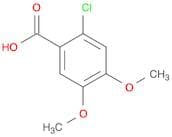
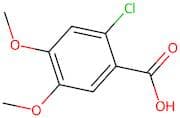
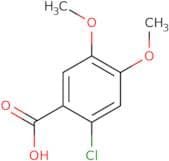
2-Chloro-4,5-dimethoxybenzoic acid is an aromatic carboxylic acid characterized by the presence of a benzoic acid core substituted with a chlorine atom and two methoxy groups. The chlorine atom is located at the 2-position, while the methoxy groups are positioned at the 4 and 5 positions on the benzene ring. This compound typically appears as a white to off-white solid and is soluble in organic solvents, with limited solubility in water due to its hydrophobic methoxy groups. It exhibits acidic properties due to the carboxylic acid functional group, allowing it to participate in various chemical reactions, such as esterification and amidation. The presence of the chlorine and methoxy substituents can influence its reactivity and biological activity, making it of interest in pharmaceutical and agrochemical research. Additionally, its structure may contribute to specific interactions in biological systems, potentially leading to applications in drug development or as a biochemical probe. Safety data should be consulted for handling and usage, as with any chemical substance.
Formula:C9H9ClO4
InChI:InChI=1/C9H9ClO4/c1-13-7-3-5(9(11)12)6(10)4-8(7)14-2/h3-4H,1-2H3,(H,11,12)
SMILES:COc1cc(c(cc1OC)Cl)C(=O)O
Sort by
Purity (%)
0
100
|
0
|
50
|
90
|
95
|
100
Found 4 products.
2-Chloro-4,5-dimethoxybenzoic acid
CAS:Formula:C9H9ClO4Purity:98%Color and Shape:SolidMolecular weight:216.61842-Chloro-4,5-dimethoxybenzoic acid
CAS:2-Chloro-4,5-dimethoxybenzoic acidPurity:98%Molecular weight:216.62g/mol2-Chloro-4,5-dimethoxybenzoic acid
CAS:Formula:C9H9ClO4Purity:98%Color and Shape:SolidMolecular weight:216.622-Chloro-4,5-dimethoxybenzoic acid
CAS:2-Chloro-4,5-dimethoxybenzoic acid is an organic compound that belongs to the class of aromatic compounds. It has been used in oxidation process as an intermediate for the production of a variety of chemicals. 2-Chloro-4,5-dimethoxybenzoic acid is produced by oxidation of acetophenone with nitric acid and sulfuric acid. The experimental data collected from this process has been modeled to determine the optimal conditions for synthesizing this chemical. The optimisation process was able to identify controllable factors that affect the efficiency of this synthesis, such as temperature and pressure, which can be controlled easily in a lab setting.Formula:C9H9ClO4Purity:Min. 95%Molecular weight:216.62 g/mol