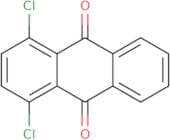
CAS 602-25-5
:1,4-dichloroanthraquinone
Description:
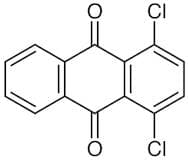
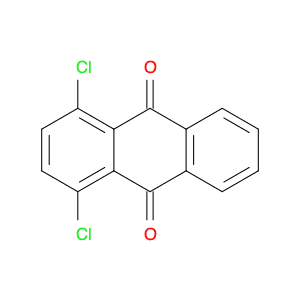
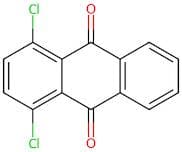
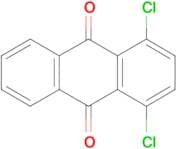
1,4-Dichloroanthraquinone is an organic compound characterized by its structure, which consists of an anthraquinone backbone with two chlorine substituents at the 1 and 4 positions. It appears as a dark crystalline solid and is known for its stability and relatively low solubility in water, but it is soluble in organic solvents such as acetone and chloroform. This compound exhibits strong absorption in the ultraviolet-visible spectrum, making it useful in various applications, including dyes and pigments. It is also utilized in the synthesis of other chemical compounds and as an intermediate in the production of certain pharmaceuticals. 1,4-Dichloroanthraquinone is considered to have moderate toxicity, and appropriate safety measures should be taken when handling it, as it may pose environmental hazards. Its chemical formula is C14H8Cl2O2, and it is classified under the category of halogenated aromatic compounds.
Formula:C14H6Cl2O2
InChI:InChI=1/C14H6Cl2O2/c15-9-5-6-10(16)12-11(9)13(17)7-3-1-2-4-8(7)14(12)18/h1-6H
SMILES:c1ccc2c(c1)C(=O)c1c(ccc(c1C2=O)Cl)Cl
Synonyms:- 1,4-Dichloroanthracene-9,10-Dione
Sort by
Purity (%)
0
100
|
0
|
50
|
90
|
95
|
100
Found 5 products.
1,4-Dichloroanthraquinone
CAS:Formula:C14H6Cl2O2Purity:>98.0%(GC)Color and Shape:Light yellow to Brown powder to crystalMolecular weight:277.109,10-Anthracenedione, 1,4-dichloro-
CAS:Formula:C14H6Cl2O2Purity:96%Color and Shape:SolidMolecular weight:277.10221,4-Dichloro-9,10-anthraquinone
CAS:1,4-Dichloro-9,10-anthraquinonePurity:99%Molecular weight:277.10g/mol1,4-Dichloroanthraquinone
CAS:1,4-Dichloroanthraquinone is a chemical compound that is used to produce the dye phthalocyanine. It can be synthesized by reacting chlorine with phthaloyl chloride in presence of Friedel-Crafts catalysts. 1,4-Dichloroanthraquinone reacts with thionyl chloride to form chloroform and phthalic anhydride, which are both colorless compounds. The reaction time for this reaction is about 5 minutes. This chemical has a high catalytic effect and can be used in the production of other dyes such as methyl violet or methyl green. It also has a high chlorine content and can be used to produce other chemicals like chlorinated rubbers or vinyl chloride.
Formula:C14H6Cl2O2Purity:Min. 95%Color and Shape:PowderMolecular weight:277.1 g/mol