

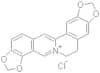
CAS 6020-18-4
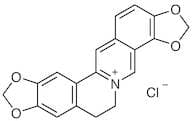
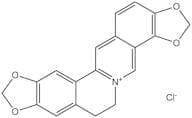
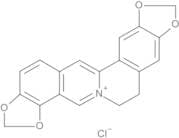
:Coptisine hydrochloride
- 6,7-Dihydro[1,3]Dioxolo[4,5-G][1,3]Dioxolo[7,8]Isoquino[3,2-A]Isoquinolin-5-Ium
- 6,7-Dihydro[1,3]Dioxolo[4,5-G][1,3]Dioxolo[7,8]Isoquino[3,2-A]Isoquinolin-5-Ium Chloride
- 7,12b-dihydro-6H-[1,3]dioxolo[4,5-g][1,3]dioxolo[7,8]isoquino[3,2-a]isoquinoline
- 7,8,13,13a-Tetradehydro-2,3:9,10-bis(methylenedioxy)berbinium chloride
- Berbinium, 7,8,13,13a-tetradehydro-2,3:9,10-bis(methylenedioxy)-, chloride
- Bis[1,3]benzodioxolo[5,6-a:4′,5′-g]quinolizinium, 6,7-dihydro-, chloride
- Bis[1,3]benzodioxolo[5,6-a:4′,5′-g]quinolizinium, 6,7-dihydro-, chloride (1:1)
- Coptisine hydrochloride
- Coptisine chloride
Coptisine Chloride
CAS:Vegetable alkaloids, natural or reproduced by synthesis, their salts and other derivatives, nesoiFormula:C19H14ClNO4Color and Shape:Orange PowderMolecular weight:355.06114Bis[1,3]benzodioxolo[5,6-a:4',5'-g]quinolizinium, 6,7-dihydro-, chloride
CAS:Formula:C19H14ClNO4Purity:98%Color and Shape:SolidMolecular weight:355.7718Coptisine Chloride
CAS:Formula:C19H14NO4ClPurity:>95.0%(T)(HPLC)Color and Shape:Light yellow to Yellow to Orange powder to crystalMolecular weight:355.77Coptisine chloride
CAS:1. Coptisine chloride (NSC-119754) can be absorbed across intestinal epithelial cells, and completely absorbed compounds.Formula:C19H14ClNO4Purity:98.85% - 99.91%Color and Shape:SolidMolecular weight:355.77Ref: TM-T5S0056
5mg62.00€10mg88.00€25mg177.00€50mg264.00€100mg394.00€500mg883.00€1mL*10mM (DMSO)69.00€Coptisin chloride
CAS:Natural alkaloidFormula:C19H14NO4ClPurity:≥ 95.0 % (HPLC)Color and Shape:PowderMolecular weight:355.78Coptisine Chloride
CAS:Controlled ProductStability Hygroscopic
Applications Coptisine is an alkaloid found in Chinese goldthread (Coptis chinensis). A bacterial collagenase inhibitor. Coptisine has been found to reversibly inhibit Monoamine oxidase A in mice, pointing to a potential role as a natural antidepressant.
References Blaney, W., et al.: Physiol. Entomol., 12, 281 (1987), Sethi, M., et al.: J. Pharm. Sci., 72, 538 (1983), Yahara, S., et al.: Chem. Pharm. Bull., 33, 527 (1985),Formula:C19H14NO4·ClColor and Shape:NeatMolecular weight:355.77Coptisine chloride
CAS:Coptisine chloride is an isoquinoline alkaloid, which is a naturally occurring compound extracted primarily from plants such as Coptis chinensis, also known as goldthread. This compound is part of a broad class of bioactive molecules prevalent in traditional Chinese medicine. Its mode of action involves the modulation of various biological pathways, including anti-inflammatory, antimicrobial, and anticancer activities. Coptisine chloride acts by interacting with cellular targets that influence gene expression and enzyme activity, thereby exerting its pharmacological effects.
Formula:C19H14ClNO4Purity:Min. 95%Molecular weight:355.77 g/molBis[1,3]benzodioxolo[5,6-a:4′,5′-g]quinolizinium, 6,7-dihydro-, chloride
CAS:Purity:99%Molecular weight:355.769989


![Bis[1,3]benzodioxolo[5,6-a:4',5'-g]quinolizinium, 6,7-dihydro-, chloride](/_next/image/?url=https%3A%2Fstatic.cymitquimica.com%2Fproducts%2FIN%2Fthumb%2FDA00IKLF.jpg&w=3840&q=75)

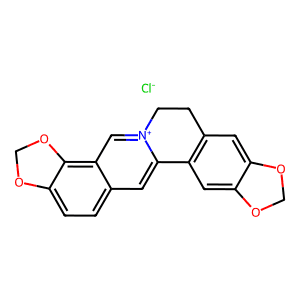

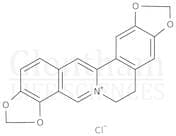

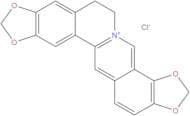





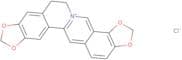

![Bis[1,3]benzodioxolo[5,6-a:4′,5′-g]quinolizinium, 6,7-dihydro-, chloride](/_next/image/?url=https%3A%2Fstatic.cymitquimica.com%2Fproducts%2F10%2Fthumb%2FF863978.jpg&w=3840&q=75)
