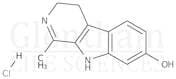
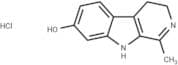
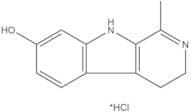
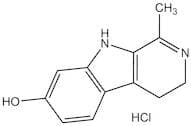
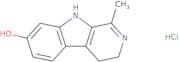
![3H-Pyrido[3,4-b]indol-7-ol, 4,9-dihydro-1-methyl-, hydrochloride (1:1)](/_next/image/?url=https%3A%2Fstatic.cymitquimica.com%2Fcas-image%2Fthumb-webp%2F343320-harmalol-hcl.webp&w=3840&q=75)
CAS 6028-07-5
:3H-Pyrido[3,4-b]indol-7-ol, 4,9-dihydro-1-methyl-, hydrochloride (1:1)
Description:
3H-Pyrido[3,4-b]indol-7-ol, 4,9-dihydro-1-methyl-, hydrochloride (1:1), with CAS number 6028-07-5, is a chemical compound that belongs to the class of indole derivatives. This substance features a fused pyridine and indole structure, which contributes to its unique chemical properties. It is typically encountered as a hydrochloride salt, enhancing its solubility in water and making it more suitable for various applications, including biological studies. The compound may exhibit biological activity, potentially influencing neurotransmitter systems or serving as a precursor in synthetic pathways. Its molecular structure includes a hydroxyl group, which can participate in hydrogen bonding, affecting its reactivity and interactions with other molecules. The compound's characteristics, such as melting point, solubility, and stability, can vary based on environmental conditions and the presence of other substances. As with many organic compounds, safety data should be consulted to understand its handling and potential hazards in laboratory settings.
Formula:C12H13ClN2O
InChI:InChI=1/C12H12N2O.ClH/c1-7-12-10(4-5-13-7)9-3-2-8(15)6-11(9)14-12;/h2-3,6,13-14H,4-5H2,1H3;1H
InChI key:InChIKey=BSWAWVOHMZNXOS-UHFFFAOYSA-N
SMILES:CC=1C2=C(C=3C(N2)=CC(O)=CC3)CCN1.Cl
Synonyms:- 1-Methyl-3,4-Dihydro-Beta-Carbolin-7-Ol Hydrochloride Monohydrate
- 1-Methyl-3H,4H,9H-pyrido[3,4-b]indol-7-ol hydrochloride
- 1-methyl-2,3,4,9-tetrahydro-7H-beta-carbolin-7-one hydrochloride
- 3H-Pyrido[3,4-b]indol-7-ol, 4,9-dihydro-1-methyl-, hydrochloride (1:1)
- 3H-Pyrido[3,4-b]indol-7-ol, 4,9-dihydro-1-methyl-, monohydrochloride
- Harmalol, hydrochloride
- NSC 640461
- HARMALOL HCL
- TIMTEC-BB SBB003241
- Harmidol hydrochloride
- 4,9-dihydro-1-methyl-3h-pyrido(3,4-b)indol-7-olhydrochloride
- See more synonyms
Sort by
Purity (%)
0
100
|
0
|
50
|
90
|
95
|
100
Found 5 products.
Harmalol hydrochloride
CAS:Harmalol hydrochloride, a β-carboline from Peganum harmala seeds, inhibits CYP1A1 and shows vasorelaxant and antioxidant properties.Formula:C12H13ClN2OPurity:99.88%Color and Shape:SolidMolecular weight:236.7Harmalol hydrochloride
CAS:Natural alkaloidFormula:C12H12N2OHClPurity:≥ 80.0 % (HPLC)Color and Shape:PowderMolecular weight:236.7Harmalol Hydrochloride
CAS:Controlled ProductHarmalol is a natural compound that has been used for centuries as a traditional medicine. Harmalol is found in the seeds of the Indian Madder plant, and it has been shown to be an effective treatment for malaria. Harmalol also inhibits mitochondrial membrane potential and induces apoptosis in murine hepatoma cells. In addition, harmalol inhibits drug-metabolizing enzymes, such as CYP3A4 and CYP2D6, which could lead to drug interactions. The effects of harmalol on mitochondrial membrane potential can be measured using a redox potential assay. Harmalol can also be analyzed using analytical methods such as chromatographic analysis or response element binding assays. Harmalol has also been shown to inhibit TNF-α production in human serum cells.Formula:C12H13ClN2OPurity:Min. 95%Color and Shape:PowderMolecular weight:236.7 g/mol