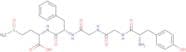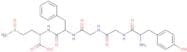
CAS 60283-51-4
:(Met(O)5)-Enkephalin
Description:
(Met(O)5)-Enkephalin, also known as a modified form of the endogenous opioid peptide enkephalin, is characterized by the substitution of the methionine residue with a sulfoxide derivative, which enhances its stability and bioactivity. This compound is part of the opioid peptide family, which plays a crucial role in pain modulation and neurotransmission. The modification at the methionine position alters its pharmacological properties, potentially increasing its affinity for opioid receptors. (Met(O)5)-Enkephalin exhibits a specific structure that allows it to interact with the mu-opioid receptor, contributing to its analgesic effects. Additionally, its solubility and stability in biological systems may be improved due to the modifications, making it a subject of interest in medicinal chemistry and drug development. The compound's unique characteristics, including its peptide nature and modified amino acid, position it as a valuable tool for studying opioid receptor interactions and developing new analgesic therapies.
Formula:C27H35N5O8S
InChI:InChI=1/C27H35N5O8S/c1-41(40)12-11-21(27(38)39)32-26(37)22(14-17-5-3-2-4-6-17)31-24(35)16-29-23(34)15-30-25(36)20(28)13-18-7-9-19(33)10-8-18/h2-10,20-22,33H,11-16,28H2,1H3,(H,29,34)(H,30,36)(H,31,35)(H,32,37)(H,38,39)/t20-,21-,22-,41?/m0/s1
SMILES:CS(=O)CC[C@@H](C(=O)O)N=C([C@H](Cc1ccccc1)N=C(CN=C(CN=C([C@H](Cc1ccc(cc1)O)N)O)O)O)O
Synonyms:- H-Tyr-Gly-Gly-Phe-Met(O)-OH
- L-tyrosylglycylglycyl-N-[(1S)-1-carboxy-3-(methylsulfinyl)propyl]-L-phenylalaninamide
Sort by
Purity (%)
0
100
|
0
|
50
|
90
|
95
|
100
Found 2 products.
(Met(O)5)-Enkephalin
CAS:Met-enkephalin is a molecule that is formed from two of the three parts of the endorphin molecule, which are Tyr-Gly-Gly-Phe and Met(O)OH. It is a neurotransmitter that has been shown to inhibit pain in humans and animals. In coelomocytes, met-enkephalin binds to receptors on the cell membrane and inhibits the release of dopamine by binding to dopamine receptors. The sulfoxide group of this molecule can be reduced to form enkephalinase, which is an enzyme that cleaves Met(O)OH from the peptide chain. This process is not known to occur in humans or other mammals. Met-enkephalin has been localized in ganglia cells in animals, but not humans. It has also been found in messenger RNA (mRNA) for translation into protein, but it does not appear to be translated into protein in humans or other mammals.Formula:C27H35N5O8SPurity:Min. 95%Molecular weight:589.66 g/mol(Met(O)5)-Enkephalin
CAS:Enkephalins are a group of endogenous peptides that are the most potent natural analgesic and have been shown to relieve pain by inhibiting neurotransmitters. The (Met(O)5)-enkephalin analog is a structural analog of the enkephalin peptide with a sulfoxide linkage at position 5. This analog has been shown to inhibit acetylcholine release from intestinal ganglia, which may be related to its effects on postsynaptic potentials and glutamate release. This compound also absorbs in the small intestine, where it is taken into the blood stream and transported to the brain. The (Met(O)5)-enkephalin analog has been shown to reduce pain in Sprague-Dawley rats, as well as inhibit intestinal transit time and stimulate intestinal motility.
Formula:C27H35N5O8SPurity:Min. 95%Molecular weight:589.67 g/mol