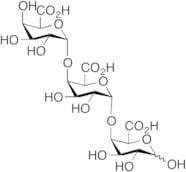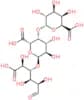
CAS 6037-45-2
:Trigalacturonic acid
Description:
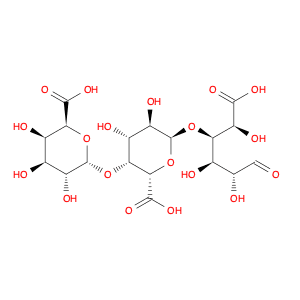
Trigalacturonic acid is a pectic polysaccharide derived from the degradation of pectin, primarily found in the cell walls of plants. It is characterized by its structure, which consists of a linear chain of galacturonic acid units linked by α-(1→4) glycosidic bonds, with three galacturonic acid residues in its repeating unit. This compound is typically formed through the partial hydrolysis of pectin, a natural polymer that contributes to the firmness and stability of plant tissues. Trigalacturonic acid is soluble in water and exhibits gel-forming properties, making it relevant in food science, particularly in the formulation of jams, jellies, and other gel-like products. Additionally, it has potential applications in pharmaceuticals and biotechnology due to its biocompatibility and ability to interact with various biomolecules. Its CAS number, 6037-45-2, is used for identification in chemical databases and regulatory contexts. Overall, trigalacturonic acid plays a significant role in both natural and industrial processes involving plant-derived materials.
Formula:C18H26O19
InChI:InChI=1S/C18H26O19/c19-1-2(20)3(21)10(9(27)14(28)29)34-18-8(26)6(24)11(13(37-18)16(32)33)35-17-7(25)4(22)5(23)12(36-17)15(30)31/h1-13,17-18,20-27H,(H,28,29)(H,30,31)(H,32,33)/t2-,3+,4-,5+,6+,7+,8+,9-,10+,11+,12-,13-,17-,18-/m0/s1
InChI key:InChIKey=FMNDXLWVYMQMHF-XKLWFNJZSA-N
SMILES:O([C@H]1[C@@H](C(O)=O)O[C@H](O[C@H]([C@@H]([C@H](C=O)O)O)[C@@H](C(O)=O)O)[C@H](O)[C@H]1O)[C@H]2O[C@H](C(O)=O)[C@H](O)[C@H](O)[C@H]2O
Synonyms:- <span class="text-smallcaps">D</smallcap>-Galacturonic acid, O-α-<smallcap>D</smallcap>-galactopyranuronosyl-(1→4)-O-α-<smallcap>D</span>-galactopyranuronosyl-(1→4)-
- Galacturonic acid, O-α-<span class="text-smallcaps">D</smallcap>-galactopyranuronosyl-(1→4)-O-α-<smallcap>D</span>-galactopyranuronosyl-(1→4)-
- Hexopyranuronosyl-(1->4)Hexopyranuronosyl-(1->4)Hexuronic Acid
- O-α-<span class="text-smallcaps">D</smallcap>-Galactopyranuronosyl-(1→4)-O-α-<smallcap>D</smallcap>-galactopyranuronosyl-(1→4)-<smallcap>D</span>-galacturonic acid
- Trigalacturonic acid
- O-α-D-Galactopyranuronosyl-(1→4)-O-α-D-galactopyranuronosyl-(1→4)-D-galacturonic acid
- D-Galacturonic acid, O-α-D-galactopyranuronosyl-(1→4)-O-α-D-galactopyranuronosyl-(1→4)-
- Galacturonic acid, O-α-D-galactopyranuronosyl-(1→4)-O-α-D-galactopyranuronosyl-(1→4)-
Sort by
Purity (%)
0
100
|
0
|
50
|
90
|
95
|
100
Found 6 products.
Trigalacturonic acid
CAS:Formula:C18H26O19Purity:≥ 90.0%Color and Shape:White powderMolecular weight:546.39Trigalacturonic Acid
CAS:Trigalacturonic acid is an oligosaccharide that inhibits proteinase activity in tomato plants (ED50 = 2.6 μg/plant).Formula:C18H26O19Color and Shape:SolidMolecular weight:546.39Trigalacturonic acid
CAS:Trigalacturonic acid, (α-1,4 galacturonotriose) is derived from pectin or pectic acid by enzymatic or partial acid hydrolysis (Combo, 2012). It is used inâ¯galacturonic acidâ¯metabolism research as a substrate to identify, differentiate, and characterize endo- and exopolygalacturonase(s), and gluconase(s) (Jayani, 2005). The addition of very short fragments of homogalacturonan, tri-galacturonate, and tetra-galacturonate oligosaccharides, restores development in dark-grown, de-etiolated seedling mutants, suggesting that they are unable to generate de-methylesterified pectin fragments. A model of spatiotemporally separated photoreceptive and signal-responsive cell types has been proposed, that contains overlapping subsets of the regulatory network of light-dependent seedling development (Sinclair, 2017).Formula:C18H26O19Purity:Min. 90 Area-%Color and Shape:White Off-White PowderMolecular weight:546.39 g/molTrigalacturonic Acid (>90%)
CAS:Controlled ProductApplications Trigalacturonic Acid, is the product of polygalacturonic acid degradation. The mixture of Oligogalacturonic Acids has shown to have shoot growth in cockscomb (Celosia argentea L.) seedlings.
References Suzuki, T., et al.: J. Plant Growth Reg., 21, 209 (2003);Formula:C18H26O19Purity:>90%Color and Shape:NeatMolecular weight:546.39