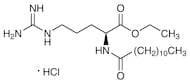
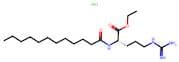
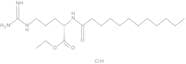
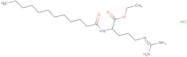
CAS 60372-77-2
:Ethyl-Nα-lauroyl-L-arginate hydrochloride
- CytoGuard LA
- L-Arginine, N2-(1-oxododecyl)-, ethyl ester, monohydrochloride
- Mirenat-N
- Ethyl Lauroyl Arginate Hydrochloride
- L-Arginine, N2-(1-oxododecyl)-, ethyl ester, hydrochloride (1:1)
- Ethyl-Nα-lauroyl-L-arginate hydrochloride
Ethyl Lauroyl Arginate Hydrochloride
CAS:Formula:C20H40N4O3·HClPurity:>95.0%(T)(HPLC)Color and Shape:White to Light yellow powder to crystalMolecular weight:421.02Ethyl Lauroyl Arginate
CAS:Non-aromatic imines and their derivatives; salts thereof, nesoiFormula:C20H41N4O3ClColor and Shape:PowderMolecular weight:420.28672ETHYL LAUROYL ARGINATE HCL
CAS:Formula:C20H41ClN4O3Purity:97%Color and Shape:SolidMolecular weight:421.0175Ethyl Lauroyl Arginate Hydrochloride
CAS:Ethyl Lauroyl Arginate HydrochlorideFormula:C20H41ClN4O3Purity:97%Color and Shape: white to yellow crystal to powderMolecular weight:421.02g/molEthyl Lauroyl Arginate Hydrochloride
CAS:Applications Ethyl Lauroyl Arginate Hydrochloride is used as a food antimicrobial in the sanitation of preserved foods. It is also used in cosmetics as a preservative.
Not a dangerous good if item is equal to or less than 1g/ml and there is less than 100g/ml in the package
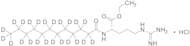
References Brandt, A. et al.: . Food. Sci., 75, M557 (2010); Taormina, P. et al.: J. Food. Prot., 72, 1216 (2009); Chem. and Eng. News Page 14, Nov. 5 (2018)Formula:C20H40N4O3·ClHColor and Shape:NeatMolecular weight:421.02Ethyl Lauroyl Arginate-d23 Hydrochloride
CAS:Controlled ProductApplications Ethyl Lauroyl Arginate-d21 hydrochloride is the isotope labelled analog of Ethyl Lauroyl Arginate Hydrochloride (E921955). Ethyl Lauroyl Arginate Hydrochloride is used as a food antimicrobial in the sanitation of preserved foods.
Not a dangerous good if item is equal to or less than 1g/ml and there is less than 100g/ml in the package
References Brandt, A. et al.: . Food. Sci., 75, M557 (2010); Taormina, P. et al.: J. Food. Prot., 72, 1216 (2009);Formula:C20D23H17N4O3·HClColor and Shape:NeatMolecular weight:444.159Ethyl lauroyl arginate hydrochloride
CAS:Ethyl lauroyl arginate hydrochloride (ELAH) is a chemical compound that inhibits the growth of bacteria. It is a quaternary ammonium salt that is stable to heat and other physical stress. ELAH has been shown to be active against Listeria monocytogenes, Salmonella enterica, Escherichia coli and Enterobacter aerogenes. ELAH may also have antimicrobial activity against other organisms, such as fungi and viruses. ELAH has been shown to cause cell lysis by disrupting the membrane of cells and interfering with the synthesis of proteins required for cell division. This agent also has a sweet taste, which can be used in food products as an artificial sweetener.
Formula:C20H40N4O3·HClPurity:Min. 95 Area-%Color and Shape:PowderMolecular weight:421.02 g/mol