CAS 60441-79-4
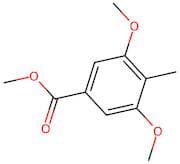
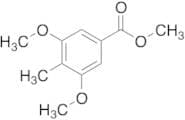
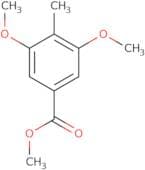
:methyl 3,5-dimethoxy-4-methylbenzoate
Description:
Methyl 3,5-dimethoxy-4-methylbenzoate, with the CAS number 60441-79-4, is an organic compound belonging to the class of benzoates. It features a benzoic acid derivative structure, characterized by the presence of a methyl ester functional group and multiple methoxy substituents on the aromatic ring. The compound typically exhibits a white to light yellow crystalline appearance and is soluble in organic solvents such as ethanol and acetone, but has limited solubility in water due to its hydrophobic nature. Its molecular structure contributes to its potential applications in the synthesis of pharmaceuticals, fragrances, and agrochemicals. The presence of methoxy groups can influence its reactivity and polarity, making it a useful intermediate in organic synthesis. Additionally, the compound may exhibit specific biological activities, although detailed studies on its pharmacological properties may be limited. As with many organic compounds, proper handling and storage are essential to ensure safety and stability.
Formula:C11H14O4
InChI:InChI=1/C11H14O4/c1-7-9(13-2)5-8(11(12)15-4)6-10(7)14-3/h5-6H,1-4H3
SMILES:Cc1c(cc(cc1OC)C(=O)OC)OC
Synonyms:- Benzoic Acid, 3,5-Dimethoxy-4-Methyl-, Methyl Ester
- METHYL 3,5-DIMETHOXY-4-METHYLBENZOATE
Sort by
Purity (%)
0
100
|
0
|
50
|
90
|
95
|
100
Found 3 products.
Methyl 3,5-Dimethoxy-4-methylbenzoate
CAS:Methyl 3,5-Dimethoxy-4-methylbenzoatePurity:95%Molecular weight:210.23g/molMethyl 3,5-Dimethoxy-4-methylbenzoate
CAS:Controlled ProductFormula:C11H14O4Color and Shape:Light BrownMolecular weight:210.233,5-Dimethoxy-4-methylbenzoic acid methyl ester
CAS:3,5-Dimethoxy-4-methylbenzoic acid methyl ester (DMMBME) is a synthetic compound that is used as an immunogen to generate antibodies against fungal proteins. DMMBME is specifically used to identify the presence of bryoria and australian fungi in plants. The chemical structure of DMMBME can be oxidized by depsidones, which leads to the production of reactive oxygen species that are believed to be responsible for the oxidative coupling of target proteins. This reaction can be catalyzed by a number of enzymes such as nidulin, which is found in plant roots.
Formula:C11H14O4Purity:Min. 95%Color and Shape:PowderMolecular weight:210.23 g/mol