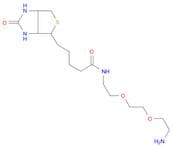
![Poly(oxy-1,2-ethanediyl), α-(2-aminoethyl)-ω-[2-[[5-[(3aS,4S,6aR)-hexahydro-2-oxo-1H-thieno[3,4-d]…](/_next/image/?url=https%3A%2Fstatic.cymitquimica.com%2Fcas-image%2Fthumb-webp%2F307431-poly-oxy-12-ethanediyl-a-2-aminoethyl-o-2-5-3as-4s-6ar-hexahydro-2-oxo-1h-thieno-34-d-imidazol-4-yl-1-oxopentyl-amino-ethoxy.webp&w=3840&q=75)
CAS 604786-74-5
:Poly(oxy-1,2-ethanediyl), α-(2-aminoethyl)-ω-[2-[[5-[(3aS,4S,6aR)-hexahydro-2-oxo-1H-thieno[3,4-d]imidazol-4-yl]-1-oxopentyl]amino]ethoxy]-
- Poly(oxy-1,2-ethanediyl), α-(2-aminoethyl)-ω-[2-[[5-[(3aS,4S,6aR)-hexahydro-2-oxo-1H-thieno[3,4-d]imidazol-4-yl]-1-oxopentyl]amino]ethoxy]-
- Biotin-PEG-amine
- EZ-Link Amine-PEGn-Biotin
Biotin-peg11-amine
CAS:Formula:C58H114N4O25SPurity:95%Color and Shape:SolidMolecular weight:1299.6026Biotin-nPEG-amine
CAS:Biotin-PEG-amine (MW 3400) is a PROTAC linker belonging to the PEG category and can be utilized in the synthesis of PROTAC molecules.Formula:(C2H4O)nC14H26N4O3SMolecular weight:1299.61Biotin-PEG23-amine
CAS:Biotin-PEG23-amineFormula:C58H114N4O25SPurity:By hplc: 99.8% (Typical Value in Batch COA)Color and Shape: white solidMolecular weight:1,299.60g/molm-dPEG®8-Thiol
CAS:m-dPEG®8-Thiol is a PEG compound with two different functional groups (also known as heterobifunctional). Unlike homobifunctional PEG compounds (same functional group on both ends), this type of compounds are more versatile as have two different anchor points. m-dPEG®8-Thiol is used as a linker and spacer to add a PEG moiety, via pegylation (a bioconjugation technique) to proteins, peptides, oligonucleotides, small molecules and nanoparticles.Formula:C34H66N4O13SPurity:Min. 95%Molecular weight:770.97 g/mol(+)-Biotin-PEG11-amine
CAS:(+)-Biotin-PEG11-amine is a PEG compound with two different functional groups (also known as heterobifunctional). Unlike homobifunctional PEG compounds (same functional group on both ends), this type of compounds are more versatile as have two different anchor points. (+)-Biotin-PEG11-amine is used as a linker and spacer to add a PEG moiety, via pegylation (a bioconjugation technique) to proteins, peptides, oligonucleotides, small molecules and nanoparticles.
Formula:C34H66N4O13SPurity:Min. 95%Molecular weight:770.97 g/molBiotin-dPEG®11-NH2
CAS:Biotin-dPEG®11-NH2 is a PEG compound with two different functional groups (also known as heterobifunctional). Unlike homobifunctional PEG compounds (same functional group on both ends), this type of compounds are more versatile as have two different anchor points. Biotin-dPEG®11-NH2 is used as a linker and spacer to add a PEG moiety, via pegylation (a bioconjugation technique) to proteins, peptides, oligonucleotides, small molecules and nanoparticles.Formula:C34H66N4O13SPurity:Min. 95%Molecular weight:770.97 g/molBiotin-dPEG®23-NH2
CAS:Biotin-dPEG®23-NH2 is a PEG compound with two different functional groups (also known as heterobifunctional). Unlike homobifunctional PEG compounds (same functional group on both ends), this type of compounds are more versatile as have two different anchor points. Biotin-dPEG®23-NH2 is used as a linker and spacer to add a PEG moiety, via pegylation (a bioconjugation technique) to proteins, peptides, oligonucleotides, small molecules and nanoparticles.Formula:C58H114N4O25SPurity:Min. 95%Molecular weight:1,299.6 g/molt-boc-N-Amido-dPEG®24-Acid
CAS:t-boc-N-Amido-dPEG®24-Acid is a PEG compound with two different functional groups (also known as heterobifunctional). Unlike homobifunctional PEG compounds (same functional group on both ends), this type of compounds are more versatile as have two different anchor points. t-boc-N-Amido-dPEG®24-Acid is used as a linker and spacer to add a PEG moiety, via pegylation (a bioconjugation technique) to proteins, peptides, oligonucleotides, small molecules and nanoparticles.
Formula:C58H114N4O25SPurity:Min. 95%Molecular weight:1,299.6 g/mol