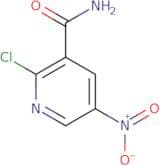
CAS 60524-15-4
:2-Chloro-5-nitro-3-pyridinecarboxamide
Description:
2-Chloro-5-nitro-3-pyridinecarboxamide, with the CAS number 60524-15-4, is a chemical compound characterized by its pyridine ring structure, which is a six-membered aromatic ring containing one nitrogen atom. This compound features a chloro group and a nitro group, which are both electron-withdrawing substituents, influencing its reactivity and properties. The presence of the carboxamide functional group contributes to its potential as a polar molecule, enhancing its solubility in polar solvents. Typically, compounds like this may exhibit biological activity, making them of interest in pharmaceutical research. The nitro group can also serve as a site for further chemical modifications. In terms of stability, the compound is generally stable under standard conditions but may require careful handling due to the presence of the nitro group, which can be sensitive to reduction reactions. Overall, 2-Chloro-5-nitro-3-pyridinecarboxamide is a versatile compound with potential applications in various fields, including medicinal chemistry and agrochemicals.
Formula:C6H4ClN3O3
InChI:InChI=1/C6H4ClN3O3/c7-5-4(6(8)11)1-3(2-9-5)10(12)13/h1-2H,(H2,8,11)
InChI key:InChIKey=ISGBAOSZUCMBKK-UHFFFAOYSA-N
SMILES:C(N)(=O)C=1C=C(N(=O)=O)C=NC1Cl
Synonyms:- 2-Chloro-5-nitro-3-pyridinecarboxamide
- 2-Chloro-5-nitronicotinamide
- 3-Pyridinecarboxamide, 2-chloro-5-nitro-
Sort by
Purity (%)
0
100
|
0
|
50
|
90
|
95
|
100
Found 2 products.
2-Chloro-5-nitronicotinamide
CAS:<p>2-Chloro-5-nitronicotinamide is a synthetic drug that has been used as an antileprosy, antimycobacterial, and chemotherapeutic agent. It is a dithiocarbamate that inhibits the synthesis of mycolic acids in mycobacteria. The interaction between 2-chloro-5-nitronicotinamide and mycolic acid is synergistic. This drug can be used to investigate the role of mycolic acids in the pathogenesis of leprosy and tuberculosis. 2-Chloro-5-nitronicotinamide is also active against footpad infections caused by erythromycin resistant strains of Mycobacterium smegmatis. It has been shown to be effective in mice when applied topically as an antimicrobial agent or when injected intravenously as an antimicrobial chemotherapy agent.</p>Formula:C6H4ClN3O3Purity:Min. 95%Molecular weight:201.57 g/mol