CAS 606-23-5
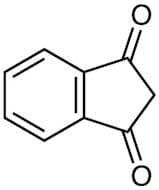
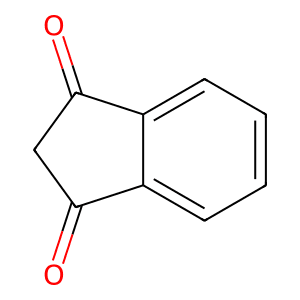
:1,3-Indandione
Description:
1,3-Indandione, with the CAS number 606-23-5, is an organic compound characterized by its bicyclic structure, which consists of a fused indene and diketone system. It appears as a yellow to orange crystalline solid and is known for its ability to undergo various chemical reactions, including condensation and oxidation. This compound is often utilized in organic synthesis and as a building block in the preparation of dyes, pharmaceuticals, and agrochemicals. Its diketone functionality allows it to participate in reactions such as Michael additions and enolate formation, making it a versatile intermediate in synthetic chemistry. Additionally, 1,3-Indandione exhibits fluorescence properties, which can be exploited in analytical applications. The compound is moderately soluble in organic solvents, and its reactivity can be influenced by the presence of substituents on the aromatic rings. Safety precautions should be taken when handling this substance, as it may pose health risks if ingested or inhaled. Overall, 1,3-Indandione is a valuable compound in both research and industrial applications.
Formula:C9H6O2
InChI:InChI=1S/C9H6O2/c10-8-5-9(11)7-4-2-1-3-6(7)8/h1-4H,5H2
InChI key:InChIKey=UHKAJLSKXBADFT-UHFFFAOYSA-N
SMILES:O=C1C=2C(C(=O)C1)=CC=CC2
Synonyms:- 1,3-Diketohydrindene
- 1,3-Dioxobenzocyclopentane
- 1,3-Indandione
- 1H-Indene-1,3(2H)-dione
- 2H-Indene-1,3-dione
- 3-hydroxy-1H-inden-1-one
- Indan-1,3-Dione
- Indan-1,3-dion
- Indandione
- Indane-1,3-dione
- Indano-1,3-Diona
- Indene-1,3(2H)-dione
- Nsc 26329
- Nsc 6312
- See more synonyms
Sort by
Purity (%)
0
100
|
0
|
50
|
90
|
95
|
100
Found 10 products.
1,3-Indandione
CAS:Formula:C9H6O2Purity:>97.0%(GC)Color and Shape:White to Light yellow to Dark green powder to crystalMolecular weight:146.151,3-Indanedione, 97%
CAS:It is used in the first stage of forensic identification of latent fingerprints. It is particularly useful for paper, and for items printed with thermal inks such as receipts. This Thermo Scientific Chemicals brand product was originally part of the Alfa Aesar product portfolio. Some documentation a
Formula:C9H6O2Purity:97%Color and Shape:White to cream or yellow to yellow-green to pale green to pale brown, Powder or crystalsMolecular weight:146.15Ref: IN-DA0032M2
1g25.00€5g26.00€10g40.00€1kgTo inquire25g60.00€50g116.00€5kgTo inquire100g169.00€10kgTo inquire500g564.00€1,3-Indanedione
CAS:Formula:C9H6O2Purity:≥ 97.0%Color and Shape:Yellow to dark-yellow or yellow-green powder or crystalsMolecular weight:146.15Indane-1,3-dione
CAS:Indane-1,3-dioneFormula:C9H6O2Purity:98%Color and Shape: light yellow to beige/brown crystalline solidMolecular weight:146.14g/mol1,3-Indanedione
CAS:1,3-Indanedione is an organic compound that is a reactive fatty acid. It reacts with copper to form a complex. The reaction mechanism of 1,3-Indanedione with copper is not yet fully understood. 1,3-Indanedione has been shown to be effective against prostate cancer cells at an optimum concentration. This compound also has potential use in the treatment of other types of cancers and as a light emitting material in photonics applications.Formula:C9H6O2Purity:Min. 95%Color and Shape:Beige PowderMolecular weight:146.14 g/mol1,3-Indanedione pure, 96%
CAS:Formula:C9H6O2Purity:min. 96.0%Color and Shape:Light yellow-green to pale green to pale brown, Crystalline powderMolecular weight:146.151,3-Indandione
CAS:Controlled ProductApplications 1,3-Indandione is one of the starting materials in the one-pot multi-component synthesis of indenone-fused heterocyclic derivatives. Also it acts as electron-withdrawing end group used for organic photovoltaic cell application.
References Bayayt, M., et al.: Tetrahedron, 73, 1196-1204 (2017); Lim, E.: Mol. Cryst. Liq. Cryst., 635, 94-101 (2016);Formula:C9H6O2Color and Shape:NeatMolecular weight:146.141,3-Indanedione, 70%
CAS:1,3-Indanedione is a precursor of indane diones that is used in the synthesis of fluorescent molecules. In the presence of light, 1,3-indanedione produces light emission and can be used as a chemiluminescent probe. In the presence of trifluoroacetic acid and copper complex, 1,3-indanedione undergoes intramolecular hydrogen transfer to form an intermediate which reacts with malonic acid to form an alkyl radical. The alkyl radical then reacts with hydrochloric acid to produce an ionic polymerization product. The biological sample is reactive with fatty acids and can be used for the detection of prostate cancer cells.Formula:C9H6O2Purity:(%) Min. 70%Color and Shape:PowderMolecular weight:146.14 g/mol