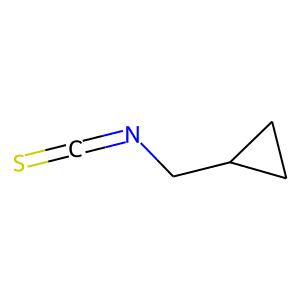
CAS 6068-90-2
:cyclopropylmethyl isothiocyanate
Description:
Cyclopropylmethyl isothiocyanate is an organic compound characterized by the presence of both a cyclopropyl group and an isothiocyanate functional group. Its molecular structure features a three-membered cyclopropane ring attached to a methyl group, which is further linked to the isothiocyanate moiety (-N=C=S). This compound is typically a colorless to pale yellow liquid with a pungent odor, characteristic of isothiocyanates, which are known for their strong and often acrid scents. Cyclopropylmethyl isothiocyanate is soluble in organic solvents but has limited solubility in water. It is primarily studied for its potential applications in organic synthesis and as a bioactive compound, particularly in the context of its role in plant defense mechanisms and potential anticancer properties. As with many isothiocyanates, it may exhibit biological activity, including antimicrobial and anticancer effects, making it of interest in both medicinal chemistry and agricultural research. Safety precautions are necessary when handling this compound due to its irritant properties.
Formula:C5H7NS
InChI:InChI=1/C5H7NS/c7-4-6-3-5-1-2-5/h5H,1-3H2
SMILES:C1CC1CN=C=S
Synonyms:- (Isothiocyanatomethyl)Cyclopropane
Sort by
Purity (%)
0
100
|
0
|
50
|
90
|
95
|
100
Found 3 products.
(Isothiocyanatomethyl)cyclopropane
CAS:(Isothiocyanatomethyl)cyclopropane
Color and Shape:Pale Yellow LiquidMolecular weight:113.18g/molCyclopropylmethylisothiocyanate
CAS:Formula:C5H7NSPurity:95.0%Color and Shape:Liquid, ClearMolecular weight:113.18(Isothiocyanatomethyl)cyclopropane
CAS:(Isothiocyanatomethyl)cyclopropane is a cyclopropane derivative that has been used to study the conformational properties of molecules in solution. It has been shown that the vibrational frequencies of (isothiocyanatomethyl)cyclopropane are strongly dependent on the solvent, temperature, and concentration. FT-IR spectra show that the molecule has a strong dipole moment and symmetrical vibrations. The theory behind this work is based on the functional theory of quantum mechanics, which predicts that the frequency of vibration should depend on the functions, intensities, and parameters of a molecule. This work also shows how conformational studies can be used to investigate different types of molecules.
Formula:C5H7NSPurity:Min. 95%Molecular weight:113.18 g/mol