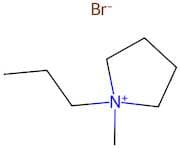
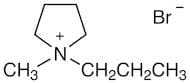
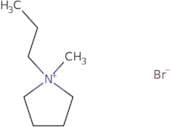
CAS 608140-09-6
:1-Methyl-1-propylpyrrolidinium bromide
- N-propyl,methylpyrrolidinium bromide
N-propyl,methylpyrrolidinium bromide
CAS:Formula:C8H18BrNPurity:98%Color and Shape:SolidMolecular weight:208.1392N-Propyl,Methylpyrrolidinium Bromide
CAS:N-Propyl,Methylpyrrolidinium BromidePurity:99%Molecular weight:208.13g/mol1-Methyl-1-propylpyrrolidin-1-ium Bromide
CAS:Formula:C8H18BrNPurity:>98.0%(T)Color and Shape:White to Light yellow to Light orange powder to crystalMolecular weight:208.141-Methyl-1-propylpyrrolidin-1-ium bromide
CAS:1-Methyl-1-propylpyrrolidinium bromide (MPPB) is a divalent ion that is highly selective for the chloride channel. It has been shown to enhance the membrane potential in neurons and muscle cells, which may be due to its ability to increase the permeability of the membrane to ions. The activation energy for MPPB is high at approximately 129 kcal/mol. MPPB has been shown to inhibit voltage-gated sodium channels in rat sciatic nerve and erythrocytes, suggesting that it may have analgesic effects. The physical properties of MPPB are cyclic with a melting point of 148 degrees Celsius and a boiling point of 155 degrees Celsius. MPPB has also been shown to bind to phenyl groups and microscopy studies revealed that it binds to cytochrome c oxidase, which is an enzyme that catalyses oxidative phosphorylation in mitochondria.
Formula:C8H18BrNPurity:Min. 95%Molecular weight:208.14 g/mol