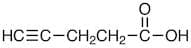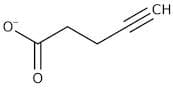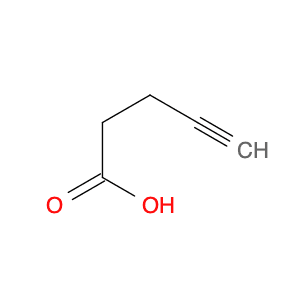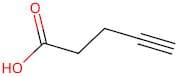
CAS 6089-09-4
:4-Pentynoic acid
Description:
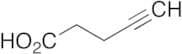
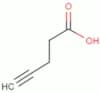
4-Pentynoic acid, with the CAS number 6089-09-4, is an alkyne carboxylic acid characterized by a five-carbon chain featuring a triple bond between the fourth and fifth carbon atoms. It has a molecular formula of C5H6O2, indicating the presence of a carboxylic acid functional group (-COOH) and an alkyne functional group. This compound is typically a colorless to pale yellow liquid with a distinct odor. It is soluble in organic solvents and exhibits limited solubility in water due to its hydrophobic carbon chain. 4-Pentynoic acid can participate in various chemical reactions, including esterification and addition reactions, making it useful in organic synthesis and as an intermediate in the production of pharmaceuticals and agrochemicals. Additionally, it may exhibit some degree of acidity, typical of carboxylic acids, allowing it to act as a proton donor in chemical reactions. Safety precautions should be taken when handling this compound, as it may be irritating to the skin and eyes.
Formula:C5H6O2
InChI:InChI=1S/C5H6O2/c1-2-3-4-5(6)7/h1H,3-4H2,(H,6,7)
InChI key:InChIKey=MLBYLEUJXUBIJJ-UHFFFAOYSA-N
SMILES:C(C(O)=O)CC#C
Synonyms:- 4-Pentynoic acid
- Brn 1742047
- Pent-4-yn-1-oic acid
- Propargylacetic acid
- Pent-4-Ynoate
- 4-02-00-01693 (Beilstein Handbook Reference)
- Pent-4-ynoic acid
Sort by
Purity (%)
0
100
|
0
|
50
|
90
|
95
|
100
Found 8 products.
4-Pentynoic Acid
CAS:Formula:C5H6O2Purity:>98.0%(GC)(T)Color and Shape:White to Orange to Green powder to crystalMolecular weight:98.104-Pentynoic acid, 95%
CAS:4-Pentynoic acid is widely utilized as a building block for the synthesis of eight sequence-defined model oligomers. Due to its triple bond at terminal carbon, it is employed as an intermediate to produce biologically active compounds. It is used as a hypoglycemic agent, which increases liver tyrosiFormula:C5H5O2Purity:95%Color and Shape:White to cream to yellow to pale brown, Crystals or crystalline powderMolecular weight:97.094-Pentynoic acid
CAS:4-Pentynoic acid used for ynenol lactones synthesis with 1-bromo-alkynes/Pd and macrolide production via ring-closing metathesis.Formula:C5H6O2Purity:≥95%Color and Shape:<54°C Solid >57°C LiquidMolecular weight:98.1Pent-4-ynoic acid,
CAS:Pent-4-ynoic acid,Formula:C5H6O2Purity:98%Color and Shape: off-white to light orange crystalline solidMolecular weight:98.10g/mol4-Pentynoic Acid
CAS:Controlled ProductApplications 4-Pentynoic Acid is a hypoglycemic agent shown to increase liver tyrosine aminotransferase and plasma corticosterone while decreasing blood sugar in rats.
Not a dangerous good if item is equal to or less than 1g/ml and there is less than 100g/ml in the package
References Fuller, R.W. et al.: Experientia, 29, 277 (1973);Formula:C5H6O2Color and Shape:NeatMolecular weight:98.14-Pentynoic acid
CAS:Formula:C5H6O2Purity:98.0%Color and Shape:Solid, Chunks or Crystalline PowderMolecular weight:98.1014-Pentynoic acid
CAS:4-Pentynoic acid (4PA) is a natural product that has been shown to inhibit the growth of prostate cancer cells. It is a hydroxylated fatty acid and an oxidative metabolite of 4-hydroxybutyrate. 4PA inhibits the production of brain natriuretic peptide, which can be a predictor of cardiovascular disease. 4PA also has regulatory effects on the uptake of calcium carbonate by cells. The chemical structure of 4PA is similar to that of 2,5-dihydroxybenzoic acid, which inhibits monolayers on the surface of iron oxides. This similarity may lead to the formation of covalent linkages with the iron oxides, leading to particle formation and isolated yield.Formula:C5H6O2Purity:Min. 98 Area-%Color and Shape:PowderMolecular weight:98.1 g/mol