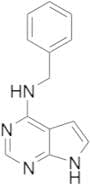
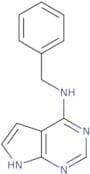
![N-benzyl-7H-pyrrolo[2,3-d]pyrimidin-4-amine](/_next/image/?url=https%3A%2Fstatic.cymitquimica.com%2Fcas-image%2Fthumb-webp%2F281576-n-benzyl-7h-pyrrolo-23-d-pyrimidin-4-amine.webp&w=3840&q=75)
CAS 60972-04-5
:N-benzyl-7H-pyrrolo[2,3-d]pyrimidin-4-amine
Description:
N-benzyl-7H-pyrrolo[2,3-d]pyrimidin-4-amine is a heterocyclic organic compound characterized by its complex bicyclic structure, which incorporates both pyrrole and pyrimidine rings. This compound features a benzyl group attached to the nitrogen atom of the pyrrolo moiety, contributing to its unique chemical properties. It is typically a solid at room temperature and may exhibit moderate solubility in polar organic solvents. The presence of amino and aromatic functional groups suggests potential for hydrogen bonding and π-π interactions, which can influence its reactivity and interactions with biological targets. N-benzyl-7H-pyrrolo[2,3-d]pyrimidin-4-amine may be of interest in medicinal chemistry due to its potential pharmacological activities, including roles in enzyme inhibition or as a scaffold for drug development. Its synthesis and characterization would involve standard organic chemistry techniques, and it may be studied for its biological properties in various research contexts. Safety data should be consulted for handling and usage, as with any chemical substance.
Formula:C13H12N4
InChI:InChI=1/C13H12N4/c1-2-4-10(5-3-1)8-15-13-11-6-7-14-12(11)16-9-17-13/h1-7,9H,8H2,(H2,14,15,16,17)
SMILES:c1ccc(cc1)CN=c1c2cc[nH]c2nc[nH]1
Sort by
Purity (%)
0
100
|
0
|
50
|
90
|
95
|
100
Found 3 products.
6-Benzylamino-7-deazapurine
CAS:Controlled ProductApplications 6-Benzylamino-7-deazapurine (cas# 60972-04-5) is a compound useful in organic synthesis.
References Tedder, M., et al.: Bioorg. Med. Chem. Lett., 14, 3165 (2004),Formula:C13H12N4Color and Shape:NeatMolecular weight:224.266-Benzylamino-7-deazapurine
CAS:6-Benzylamino-7-deazapurine is a drug that has been shown to be effective in the treatment of pancreatic cancer. It is a monomer that reacts with nucleophiles such as 6-mercaptopurine, which are present in the human lung. The reaction generates an exergonic molecule that can be used to generate ATP and regenerate NAD+ during irradiation. This process has been observed using kinetic studies on human colon adenocarcinoma cells. 6-Benzylamino-7-deazapurine can also react with triazole compounds to form a linker and increase the rate of polymerization. The optimization of this reaction time could lead to more efficient cancer treatments.Formula:C13H12N4Purity:Min. 95%Color and Shape:PowderMolecular weight:224.26 g/mol